What Are Asset-Backed Investments -and Why Do They Outperform Stocks?
Most investors spend their entire career in the stock market -only to discover, usually during a correction, that the companies they owned were priced on sentiment rather than substance. Here is a complete guide.
The Short Answer: What Are Asset-Backed Investments?
An asset-backed investment is capital deployed into -and secured by -tangible physical or operational assets such as gold bullion, real estate, commodity inventory, or mining operations. Unlike stocks or bonds, which are paper claims on company value or debt, asset-backed investments derive their returns from the performance of real underlying assets. The intrinsic value of those assets acts as a natural capital floor, independent of market sentiment.
If you have owned a stock, you have owned a fractional claim on a company's future earnings as priced by the market on any given day. On a good day, that price rises. On a bad day -a rate hike, a geopolitical shock, a single earnings miss -it falls, often with no change in the underlying business whatsoever.
Asset-backed investments cut that dependency. When your capital is deployed into physical gold that is bought, traded, and resold -as in a gold trading investment -or into a real estate development investment that generates returns upon completion, the return mechanism is operational rather than perceptual. The market does not need to agree with you for the trade to work.
This is not a new idea. Pension funds, sovereign wealth funds, and family offices have allocated to real assets for decades. What has changed is access -platforms now allow qualified individual investors to enter the same operational structures from $50,000.
How Asset-Backed Investment Actually Works
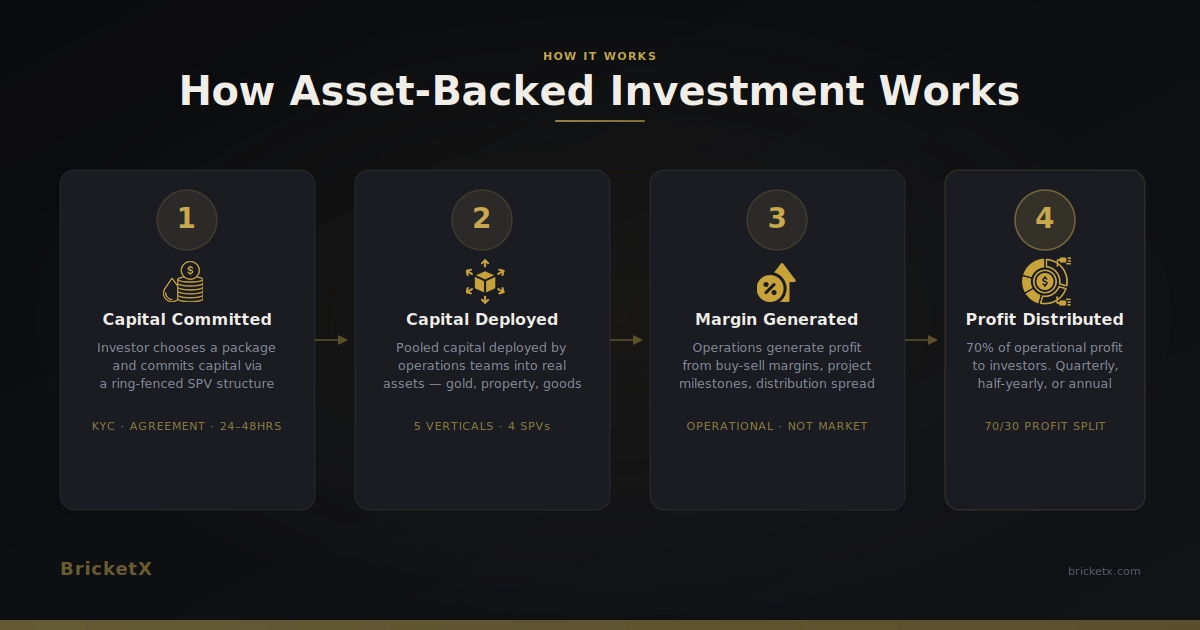
The mechanics depend on the asset class, but the core flow is consistent across all forms of asset-backed investment:
Capital is committed to a defined structure
Investor capital is pooled through a legally structured vehicle -typically a Special Purpose Vehicle (SPV) -dedicated to a specific asset or operational vertical. The SPV ring-fences your capital from unrelated activities and from the platform's own balance sheet.
Capital is deployed into real-asset operations
Operations teams deploy the pooled capital into the actual activity -purchasing gold for trading, financing a construction phase, acquiring commodity inventory for distribution. Every dollar has a physical or operational counterpart at all times.
Operations generate margin
Returns are produced by the spread between the cost of the asset operation and its output -the buy-sell margin on gold trades, the distribution margin on commodities, the project profit on a completed real estate development. This margin exists regardless of what the stock market does on any given day.
Investors receive their profit share
Operational profit is distributed to investors according to an agreed split -at BricketX, this is 70% to investors and 30% to the platform -on a defined payout cycle (quarterly, half-yearly, or annual depending on the vertical). At tenure end, the original capital is returned.
The key distinction: in a stock, you need the market to value the company more tomorrow than today to profit. In an asset-backed investment, you need the operations to generate margin -a separate and usually more predictable condition.
The Five Main Asset Classes in Asset-Backed Investment
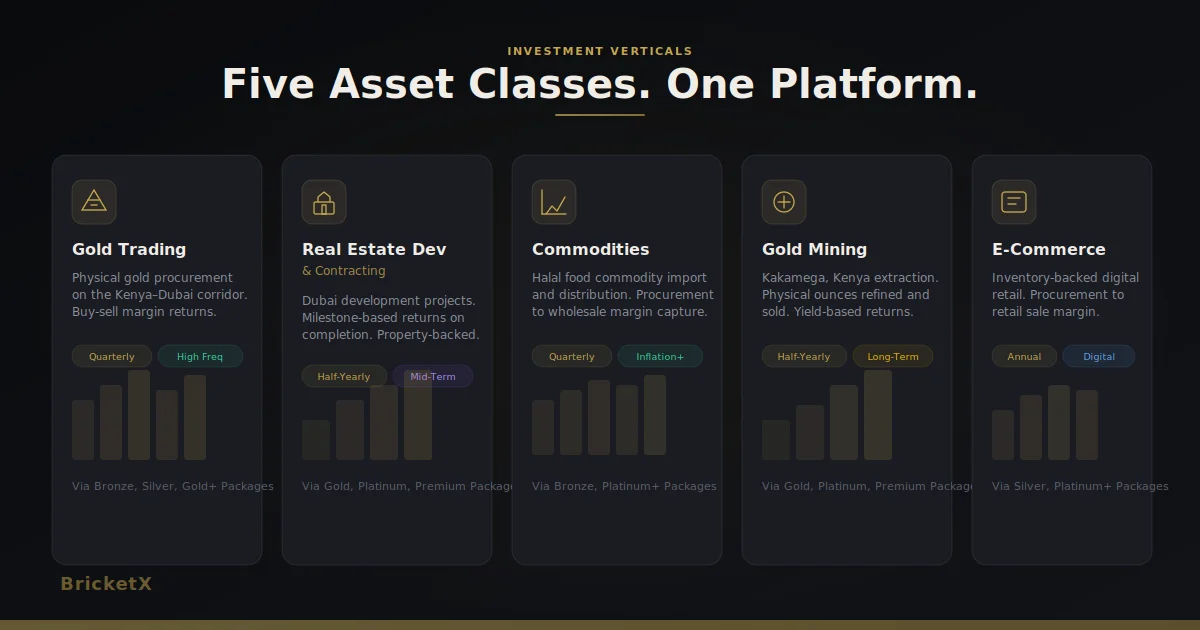
Asset-backed investment is not a single product -it is a category. The underlying asset class determines the return mechanism, risk profile, payout frequency, and minimum tenure. Here are the five most common verticals:
Gold Trading
Capital finances physical gold procurement -typically along active corridors like Kenya to Dubai. Returns come from the buy-sell trading margin. High frequency, quarterly payouts.
Real Estate Development
Capital funds construction and development phases. Returns are generated at project completion milestones, typically paid half-yearly. Backed by physical property at every stage.
Commodities
Capital finances import and wholesale distribution of physical goods -halal agricultural products, food commodities. Margin comes from procurement-to-distribution spread. Explore commodities investment →
Gold Mining
Capital funds extraction operations at active mine sites. Returns derive from gold yield -physical ounces extracted, refined, and sold. Longer-tenure, higher-return potential.
E-Commerce
Capital backs inventory-backed e-commerce investment operations. Returns come from the margin between inventory procurement cost and retail sale price. Annual payouts; digital-first model.
Multi-Asset Fund
Capital is distributed across all five verticals simultaneously, dynamically managed for return optimisation. Best diversification profile across a single investment structure.
Each vertical has a different return profile, risk level, and payout cycle. Sophisticated investors often access multiple verticals simultaneously -either through a multi-asset investment fund or through separate investment package positions -to smooth return distribution across the calendar year.
Asset-Backed Investments vs Stocks: The Real Difference
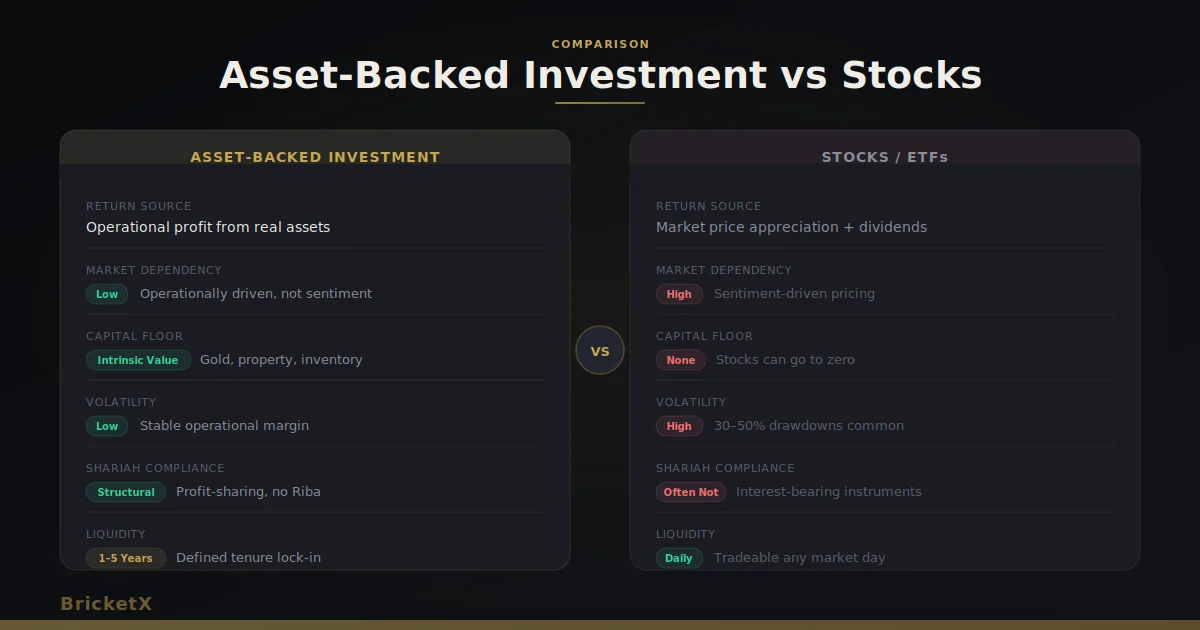
This is the comparison most investors need to understand before allocating. The difference is not just about returns -it is about the source of returns and what conditions are required for them to materialise.
| Factor | Stocks / ETFs | Asset-Backed |
|---|---|---|
| Return source | Market price appreciation + dividends | Operational profit from real-asset activities |
| Market dependency | High | Low |
| Capital floor | None | Intrinsic asset value |
| Liquidity | Daily | Defined tenure |
| Volatility | High | Low |
| Transparency | Company financials (quarterly) | SPV operational reports + audits |
| Shariah compliance | Often Not | Structurally Compliant |
| Minimum entry | $0 (fractional ETFs) | $50,000 (professional platforms) |
| Inflation hedge | Partial | Strong |
"The stock market is a device for transferring money from the impatient to the patient. Asset-backed investment, done properly, removes the market from the equation entirely -your returns come from what the business actually does, not what other investors think it is worth."
-BricketX Investment Perspective
The important nuance: asset-backed investment is not a replacement for stocks for most investors. It is a complement. A portfolio that holds liquid equities alongside illiquid real-asset positions captures both market upside and operational stability. The proportion depends on your liquidity needs, risk tolerance, and tenure flexibility.
Why Asset-Backed Investments Can Outperform Stocks
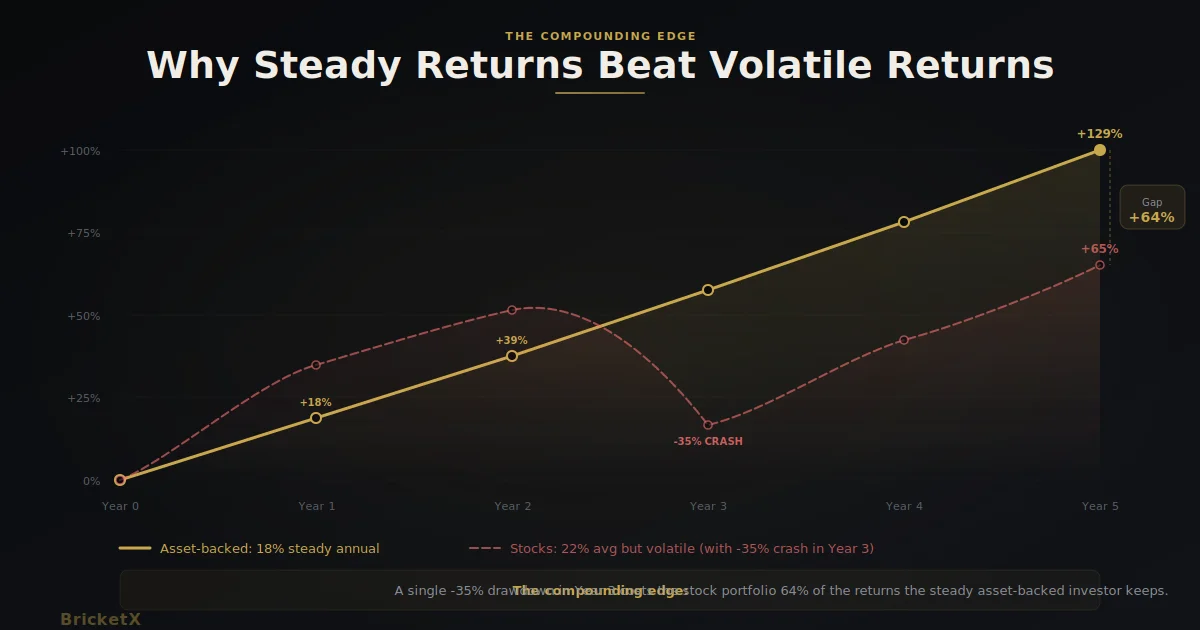
During periods of market stress -rate hikes, geopolitical shocks, recession fears -equity markets can lose 30 to 50% of value in months. In the same periods, what typically happens to gold, real estate development, and commodity distribution?
- Gold rises: It is the classic safe-haven asset. When equities fall, capital rotates into gold. An investor with direct gold trading investment exposure does not merely benefit from spot price -they benefit from increased trading volume and margin as demand rises.
- Commodity distribution continues: Food commodities must move regardless of equity market conditions. The commodities trading investment margin is relatively insulated from financial market sentiment.
- Real estate development proceeds on milestones: A construction project that is 60% complete does not stop because the S&P 500 corrected 25%. The development schedule drives the return, not the index.
This is the structural argument for outperformance: not that asset-backed investments generate higher returns in bull markets (they may or may not), but that they preserve and continue generating returns in bear markets where equity investors are absorbing significant losses.
Compounded over a 5-year period, the difference between steady operational returns and volatile market returns with two major drawdowns is often substantial -even if the stated annual return rates appear similar.
The compounding edge: An asset-backed investment returning a consistent 18% annually outperforms an equity investment that averages 22% annually but loses 35% in year 3. The numbers compound in entirely different ways once you include real drawdown events.
The Risks You Should Know
Asset-backed investments carry genuine risks. Any honest guide must address them directly.
Operational Risk
The biggest risk is not market risk -it is the risk that the operations team executing the investment performs poorly. A gold trading operation can underperform if procurement is mismanaged. A real estate development investment can delay if construction execution is poor. Mitigant: choose platforms with audited track records, experienced operations teams, and independent SPV oversight.
Liquidity Risk
Asset-backed investments are not liquid like stocks. Your capital is committed for a defined tenure -1 year for a Bronze package, up to 5 years for a Premium package. Early exit is typically subject to platform liquidity conditions and may involve penalties. Mitigant: only commit capital you will not need during the tenure period. Never deploy emergency funds or short-horizon capital into asset-backed structures.
Concentration Risk
Allocating heavily into a single asset class -100% into gold mining investment, for example -concentrates exposure to one operational vertical. If mining operations face regulatory issues or site-level challenges, the impact is outsized. Mitigant: diversify across verticals, either through a multi-asset investment fund or multiple package positions.
Platform Risk
If the platform itself fails -governance failure, regulatory action, or fraud -investor capital could be at risk regardless of how well the underlying assets perform. Mitigant: use SPV-structured platforms where investor capital is legally separated from the platform's own balance sheet. Audit the legal structure, not just the returns claimed.
None of these risks make asset-backed investment a poor choice. They make it a choice that requires more due diligence than buying an ETF. For investors who do that diligence -verifying the SPV structure, auditing the operations track record, reviewing independent auditor reports -asset-backed investment can be a powerful portfolio component.
For a detailed breakdown of how BricketX structures capital protection across six layers, see the Trust & Security page.
How BricketX Structures Asset-Backed Investment
BricketX is an asset-backed investment platform built around five operational verticals -Gold Trading, Real Estate Development & Contracting, Gold Mining, Commodities, and E-Commerce -accessed through six investment packages structured as SPVs.
The structural elements that matter for investors:
- Ring-fenced SPVs: Each vertical operates through a separate Special Purpose Vehicle (Mintrix, Mintrix Contracting LLC, Mintrix Trading LLC, BricketX Digital). Capital in one SPV cannot be reached by creditors or operational problems in another. How SPVs protect your capital →
- 70/30 profit split: Investors receive 70% of operational profit generated by the SPVs they are allocated to. BricketX retains 30%. This alignment model means the platform profits only when investors profit.
- Zero leverage: No borrowed capital is used to amplify operations. Every operation is funded entirely by investor capital and operational revenue. This eliminates interest exposure and makes the structure Shariah-compliant.
- Physical asset backing at every stage: Whether capital is in gold inventory, a development project in progress, or commodity stock, there is always a tangible asset representing the deployed position.
- Quarterly independent audits: Operations are audited independently on a quarterly basis. Investors receive operational reports tied to their package payout cycle.
The six packages -Bronze (1yr), Silver (2yr), Gold (3yr), Platinum (4yr), Premium (5yr), and the Multi-Asset Fund (1–5yr flexible) -provide access from $50,000 via BricketX's structured investment packages, with varying vertical allocations and return profiles across the tenure range.
Ready to Explore Asset-Backed Investment?
Review BricketX's six investment packages, each structured with SPV ring-fencing, 70/30 profit sharing, and physical asset backing at every stage. Minimum $50,000.
Frequently Asked Questions
What are asset-backed investments?
How does asset-backed investment work?
Why do asset-backed investments outperform stocks?
Are asset-backed investments safe?
What is the difference between asset-backed investment and ETFs?
What is a good minimum investment for asset-backed platforms?
More from the BricketX Blog
Is Gold a Safe Investment Asset in 2026? What HNWIs Need to Know
Gold is a safe haven, not a risk-free asset. Here is what high-net-worth investors need to know in 2026 before allocating.
Asset-Backed vs Stock Market: Which Investment Protects Capital Better?
A downturn is the only honest test of an investment. Here's a direct comparison of how asset-backed investments and the stock market each protect your capital, and where the real trade-offs lie.
Investing in Construction Projects Globally: A Guide for International Investors
You don't need a local company or a lawyer in three jurisdictions to put capital into a construction project abroad - but you do need to know exactly what stands between you and that project first.