Asset-Backed vs Stock Market: Which Investment Protects Capital Better?
A downturn is the only honest test of an investment. Here's a direct comparison of how asset-backed investments and the stock market each protect your capital, and where the real trade-offs lie.
A downturn is the only honest test of an investment. In the last three major market corrections, stock investors watched 30 to 50% of their capital disappear in a matter of months -often while the underlying businesses kept operating normally. Asset-backed investors, holding gold, real estate, and commodities, frequently did not. Here is a direct comparison of how each protects your capital, where the real trade-offs lie, and what the alternatives to the stock market actually look like.
The Short Answer: Asset-Backed vs Stock Market
Asset-backed investments are secured by tangible assets -gold, real estate, commodities -whose intrinsic value sets a floor under your capital, and they generate returns from operational activity. Stock market investments are claims on company value priced by daily investor sentiment, with no floor. In a downturn, asset-backed capital is protected by real-asset value; stock capital is exposed to the full swing of market mood. Neither is risk-free -but they fail in fundamentally different ways.
Ask "which protects capital better?" and the honest answer is: it depends on what threatens your capital. Against a market crash, asset-backed investments are more defensive, because a physical asset does not lose its value simply because traders panic. Against being locked out of your money when you suddenly need it, stocks win, because they can be sold on any trading day.
So the comparison is not "safe versus risky." It is sentiment risk versus liquidity risk -and understanding that single distinction changes how you build a portfolio. The rest of this guide breaks down exactly how each behaves, backed by the mechanics rather than marketing.
The Core Difference: You Own Value, or You Own Sentiment
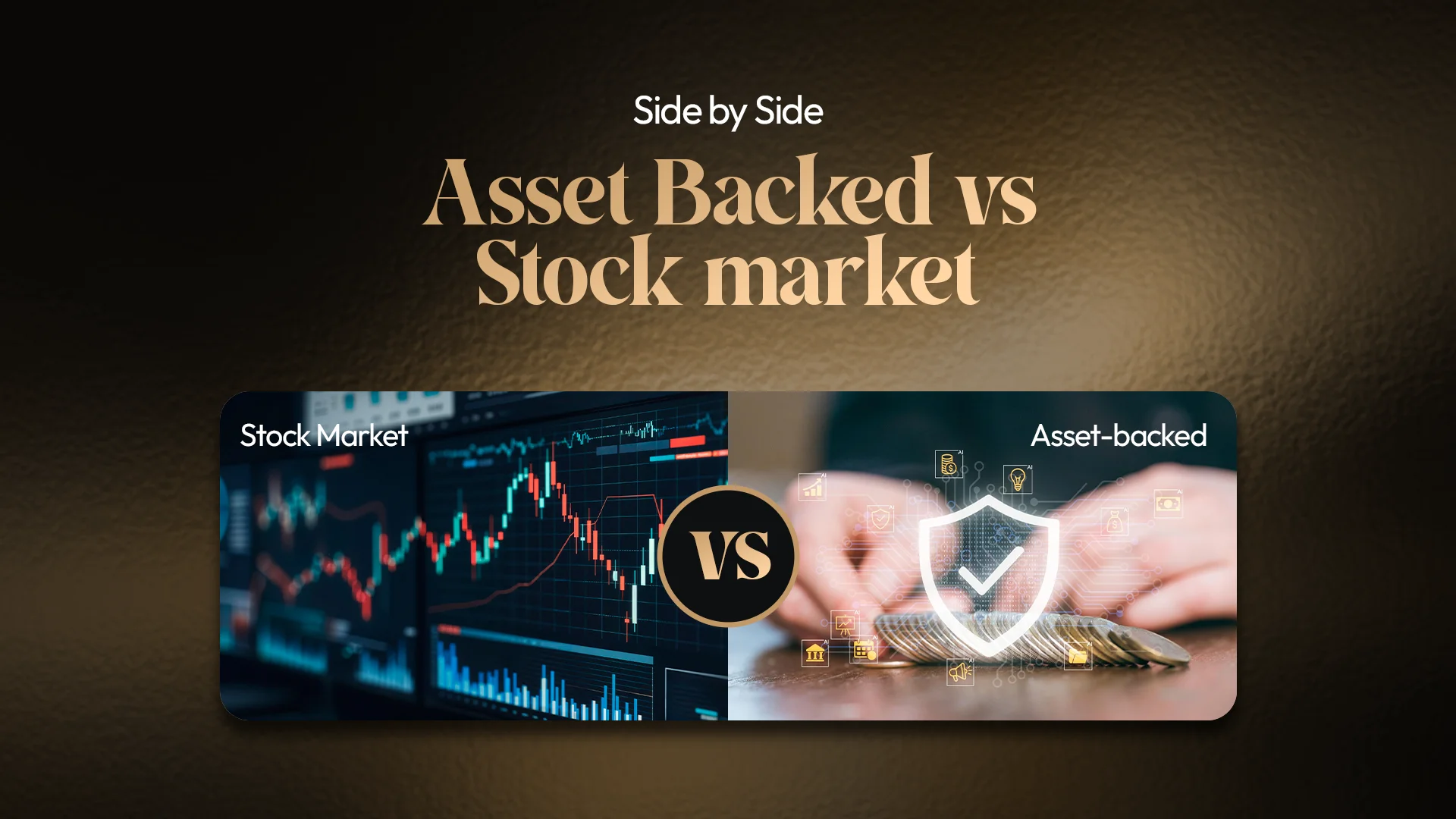
Every investment return comes from somewhere. The single most important question you can ask about any investment is: where does my return actually come from? For stocks and asset-backed investments, the answers could not be more different.
Stocks: your return depends on the next buyer
When you buy a share, you profit only if someone later pays more for it than you did. That price is set by collective sentiment -earnings expectations, interest rates, headlines, mood. A profitable company can still see its shares fall 40% because the market decided to reprice risk. You do not control, and cannot predict, the next buyer's opinion.
Asset-backed: your return depends on operations
When your capital is deployed into a gold trading investment or a real estate development investment, the return comes from the margin the operation produces -the spread on a gold trade, the profit on a completed building, the markup on distributed commodities. The market does not need to agree with you for the trade to work.
The floor is the difference-maker
A share certificate has no intrinsic value -its worth is entirely what the market assigns. Physical gold, land, and commodity inventory retain value regardless of sentiment. That intrinsic value acts as a capital floor: it limits how far your capital can fall, which is the core of capital protection.
The one-line summary: in the stock market, you profit when opinion of a company improves. In an asset-backed investment, you profit when an operation produces margin. One depends on perception; the other on performance.
Capital Protection: What Actually Happens in a Downturn
This is the section that matters most for the question in the title. Capital protection is not tested in a bull market -it is tested when everything falls. So what happens to each investment type when markets correct sharply?
What happens to stocks
In a broad correction, equity indices commonly fall 25 to 35%, and individual stocks far more. The decline is driven by sentiment and forced selling, not necessarily by any change in the businesses themselves. Recovery can take years, and an investor who needs to sell during the drawdown crystallises the loss permanently. The capital floor is effectively zero -a share can, in the extreme, go to nothing.
What happens to asset-backed investments
- Gold typically rises. It is the classic safe-haven asset. When equities fall, capital rotates into gold -so an investor with direct gold trading exposure often benefits from both higher prices and increased trading volume and margin.
- Commodity distribution continues. Food and essential commodities must keep moving regardless of what equity markets do. The commodities distribution margin is largely insulated from financial-market sentiment.
- Real estate development runs on milestones. A project that is 60% built does not halt because an index dropped 25%. The development schedule drives the return, not the market mood.
- The underlying asset retains value. Even in the worst operational case, the capital is tied to something real -bullion, land, inventory -that holds intrinsic worth. That is the floor stocks do not have.
The compounding edge: an asset-backed investment returning a steady 18% a year outperforms an equity holding that averages 22% but loses 35% in a single bad year. Drawdowns break compounding -and avoiding them is where asset-backed capital protection pays off over a full cycle.
Asset-Backed vs Stock Market: Side by Side
The clearest way to weigh the two is head to head, across the dimensions that decide how your capital behaves over a full market cycle:
| Dimension | Stock Market | Asset-Backed Investment |
|---|---|---|
| Return source | Share-price movement driven by sentiment Market-led | Operational margin from real assets Operations-led |
| Capital floor | None -a share can fall to zero No floor | Intrinsic value of the underlying asset Real-asset floor |
| Behaviour in a crash | Falls with the market, often sharply Exposed | Gold rises; operations continue Defensive |
| Volatility | High, daily, sentiment-driven High | Low -no daily repricing Low |
| Liquidity | Sell on any trading day Daily | Locked for a defined tenure (1–5 yrs) Illiquid |
| Inflation protection | Mixed -depends on the sector Variable | Strong -gold and commodities track inflation Strong |
| Minimum entry | Very low -a single share Low barrier | Typically $50,000+ Higher barrier |
| Main risk | Market sentiment / repricing Sentiment risk | Operations, liquidity, platform quality Operational risk |
Read the table honestly and the trade-off is obvious: stocks win on liquidity and low entry cost; asset-backed investments win on capital protection, low volatility, and inflation defence. There is no single winner -there is a right tool for each job.
Alternative Investments Beyond the Stock Market
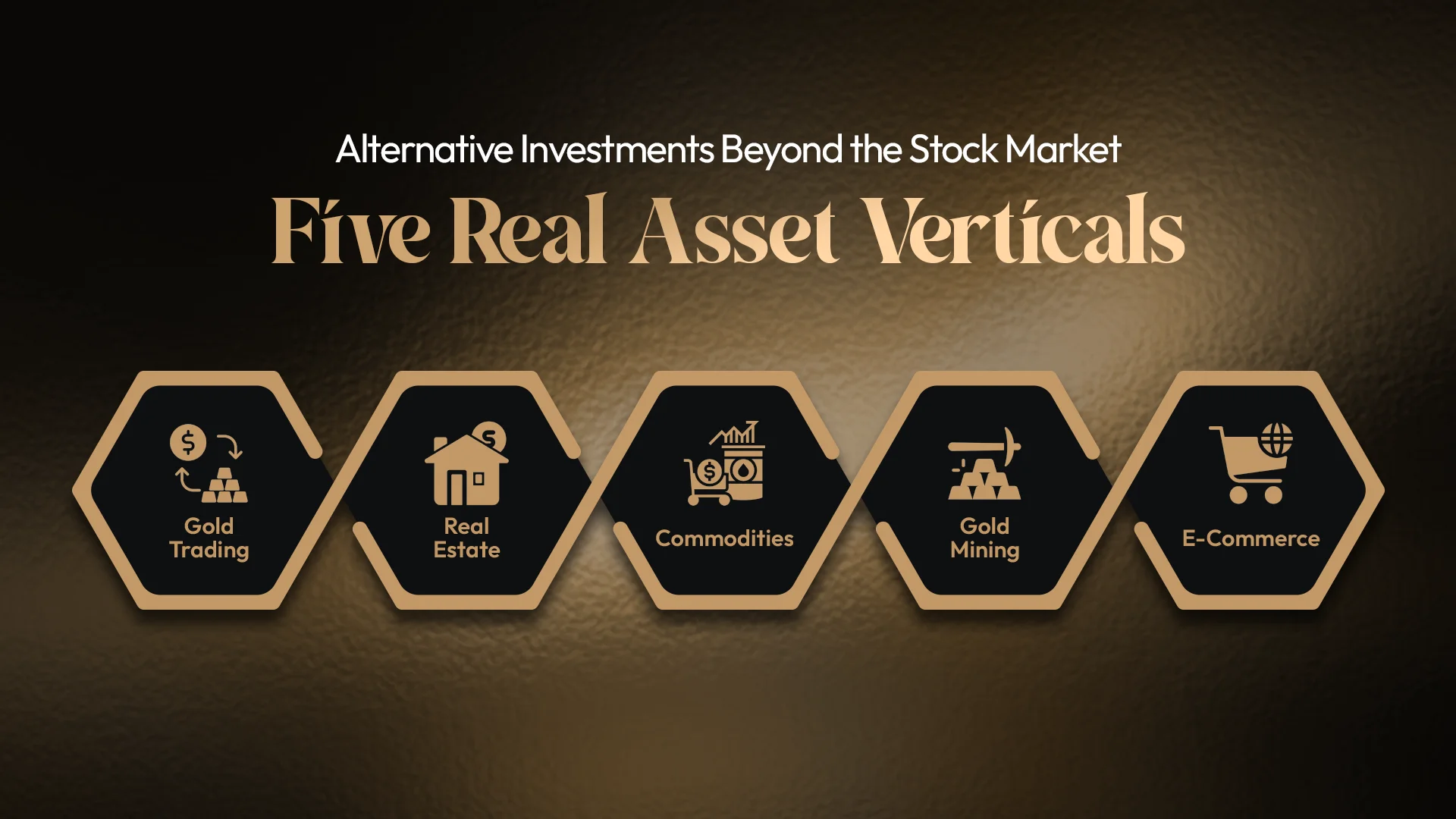
"Asset-backed" is not one product -it is a category of alternative investments beyond the stock market. Each vertical carries its own return mechanism, risk profile, and tenure. These are the five most common real-asset alternatives, all of which generate returns independently of share prices:
Gold Trading
Capital finances the procurement and resale of physical gold, earning the margin on the buy-sell spread -the classic safe-haven allocation.
Real Estate Development
Capital funds construction and contracting; returns come from project completion and sale, on a milestone schedule rather than a market clock.
Commodities
Capital finances the import and wholesale distribution of physical goods, earning distribution margin -demand that persists through market cycles.
Gold Mining
Capital funds extraction operations; investors share in the yield proceeds -higher potential return with a different, site-level risk profile.
E-Commerce
Capital funds private e-commerce inventory and operations, earning operational margin from real product sales rather than share-price speculation.
These alternatives are why professional allocators -pension funds, sovereign wealth funds, family offices -have held real assets alongside equities for decades. What has changed is access: platforms now let qualified individual investors enter the same structures from $50,000 through tiered investment packages.
Which One Is Right for You?
The most damaging myth in this comparison is that you must choose one. You do not. The strongest portfolios hold both -and the real decision is about proportion, not exclusivity.
"The stock market is a device for transferring money from the impatient to the patient. Asset-backed investment, done properly, removes the market from the equation entirely -your returns come from what a business actually does, not what other investors think it is worth."
-BricketX Investment Perspective
A practical way to think about it:
- Keep liquid equities for the capital you may need at short notice and for broad, long-term market upside.
- Add asset-backed positions for the capital you can commit for a defined tenure and want insulated from market drawdowns.
- Match tenure to need. Never place emergency or short-horizon money into an illiquid asset-backed structure, however attractive the return.
- Diversify within the alternative allocation across several verticals -or a single multi-asset fund -rather than concentrating in one.
For most investors, an allocation to alternatives sized to their liquidity comfort captures market upside while smoothing out the equity drawdowns that quietly destroy long-term compounding.
The Risks on Both Sides
An honest comparison names the risks of both, not just one.
Stock market risk
The dominant risk is sentiment: prices can fall sharply and stay down for years, independent of business fundamentals. Concentration in a single stock or sector amplifies this. The mitigant is diversification and a long enough horizon to ride out corrections -but neither removes the exposure to market mood.
Asset-backed risk
The dominant risks are different. Operational risk -the team running the asset must execute well. Liquidity risk -capital is committed for the tenure (1 year for a Bronze package, up to 5 years for Premium), so early exit may carry penalties. Concentration risk -over-allocating to a single vertical. Platform risk -if the platform is poorly governed, capital can be at risk even when the assets perform.
The mitigants are structural: choose platforms with audited track records, ring-fenced SPV structures that legally separate your capital from the platform's balance sheet, and diversified exposure. For a full breakdown of how BricketX layers capital protection, see the Trust & Security page.
How BricketX Structures Capital Protection
BricketX is an asset-backed investment platform built around five operational verticals -Gold Trading, Real Estate Development & Contracting, Gold Mining, Commodities, and E-Commerce -accessed through six investment packages structured as SPVs. The design choices that matter for protecting your capital:
- Ring-fenced SPVs: each vertical operates through a separate Special Purpose Vehicle (Mintrix, Mintrix Contracting LLC, Mintrix Trading LLC, BricketX Digital). Capital in one SPV cannot be reached by creditors or problems in another. How SPVs protect your capital →
- 70/30 profit split: investors receive 70% of the operational profit from the SPVs they are allocated to; BricketX retains 30%. The platform profits only when investors profit.
- Zero leverage: no borrowed capital is used to amplify operations. This removes interest exposure and makes the structure Shariah-compliant.
- Physical asset backing at every stage: whether in gold inventory, a development in progress, or commodity stock, there is always a tangible asset representing the deployed position.
- Quarterly independent audits: operations are independently audited, and investors receive operational reports tied to their package payout cycle.
The six packages -Bronze (1yr), Silver (2yr), Gold (3yr), Platinum (4yr), Premium (5yr), and the Multi-Asset Fund (1–5yr flexible) -provide access from $50,000, with different vertical allocations and return profiles across the tenure range.
See How BricketX Protects Your Capital
Review six asset-backed packages, each with SPV ring-fencing, a 70/30 profit split, zero leverage, and physical asset backing at every stage. Minimum $50,000.
Frequently Asked Questions
What is the difference between asset-backed investments and the stock market?
Which is safer: asset-backed investments or stocks?
What are alternative investments beyond the stock market?
Can asset-backed investments lose money?
Should I replace my stocks with asset-backed investments?
How much of my portfolio should be in alternative investments?
This article is for informational and educational purposes only and does not constitute financial advice, an offer to sell, or a solicitation to buy any investment product. All figures referenced are illustrative of general investment principles unless otherwise attributed to specific BricketX package documentation. Asset-backed investments carry operational, liquidity, concentration, and platform risks. Capital committed is subject to defined tenure lock-in. Stock market investments carry market risk and can lose value. Past operational performance does not guarantee future results. Returns stated are targets, not guarantees. KYC/AML verification is required for all investment participation. Prospective investors should conduct their own due diligence and consult a qualified financial adviser.
More from the BricketX Blog
Is Gold a Safe Investment Asset in 2026? What HNWIs Need to Know
Gold is a safe haven, not a risk-free asset. Here is what high-net-worth investors need to know in 2026 before allocating.
Investing in Construction Projects Globally: A Guide for International Investors
You don't need a local company or a lawyer in three jurisdictions to put capital into a construction project abroad - but you do need to know exactly what stands between you and that project first.
Safe Asset-Backed Investments During Inflation: What Actually Works in 2026
Cash and bonds lose to inflation by design. Here's what the 2026 data actually shows works instead -real assets, asset-backed structures, and how to tell a genuine inflation hedge from one that only wears the label.