How Asset-Backed Investment Platforms Work: A Step-by-Step Guide
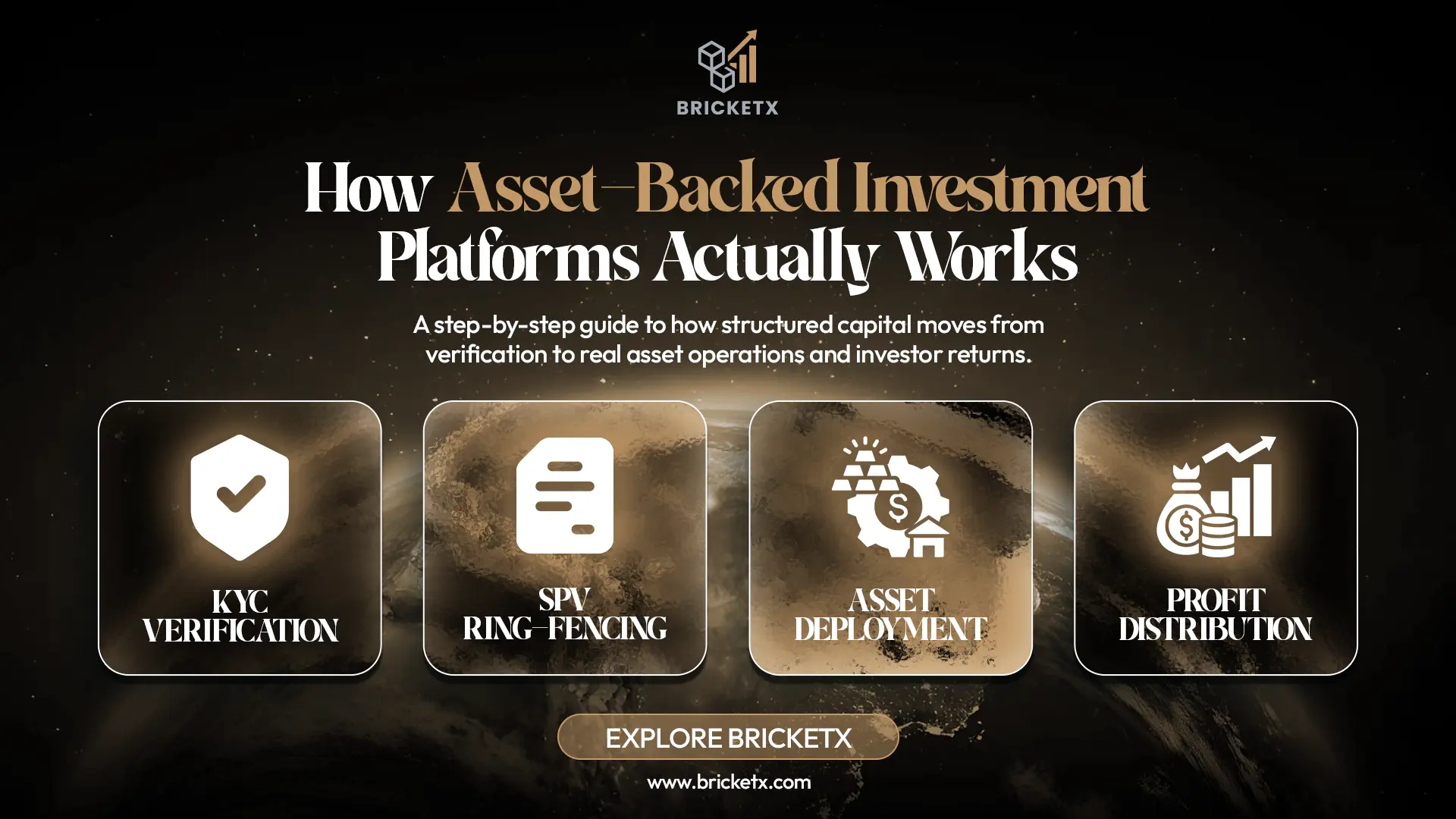
You can understand what an asset-backed investment is and still have no idea what actually happens to your money once you commit it. This guide opens the machine and walks you through every stage.
You can understand what an asset-backed investment is and still have no idea what actually happens to your money once you commit it. This guide opens the machine and walks you through every stage - from the moment you complete KYC to the day your capital is returned - so you know exactly where your money goes, how it earns, and how to tell a properly structured platform from a dangerous one.
The Short Answer: What Is an Asset-Backed Investment Platform?
An asset-backed investment platform is a structured operator that pools investor capital, ring-fences it inside a dedicated legal vehicle, and deploys it into real-asset operations - gold trading, real estate development, commodities, or mining - then returns the operational profit to investors on a defined cycle. Unlike a brokerage that simply gives you access to buy stocks, an asset-backed platform actively runs the underlying assets on your behalf and pays you from the margin those operations generate.
Most people picture an investment platform as a screen with a "buy" button. You log in, pick a fund, click, and hope the number goes up. An asset-backed platform is a different kind of machine entirely. Behind your dashboard sits a chain of legal structures, operations teams, and audit checkpoints - and your capital moves through all of them before it earns a cent.
That machinery is exactly what makes the difference between a platform that protects your capital and one that quietly puts it at risk. So instead of talking in abstractions, this guide follows a single dollar of your capital from the moment you sign up to the moment it comes back - with returns attached. If you want the underlying concept first, start with our primer on what asset-backed investments are and why they differ from stocks.
The Investment Lifecycle: 8 Steps From Sign-Up to Payout
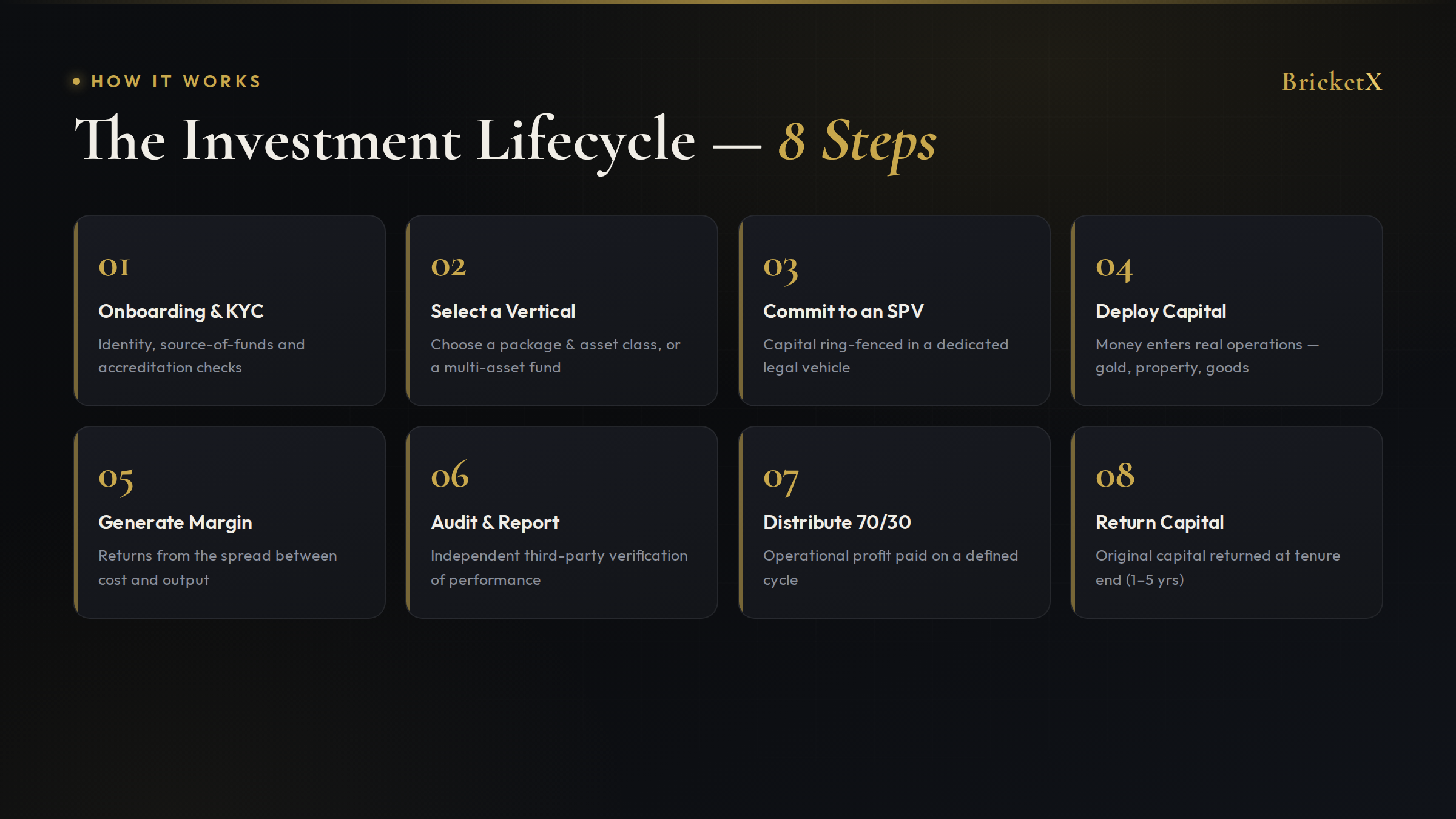
Every legitimate asset-backed platform follows the same core lifecycle, regardless of which asset class you choose. The details shift by vertical - a gold trade completes in weeks, a construction phase takes months - but the sequence below holds across all of them.
Onboarding & KYC verification
You register and complete identity, source-of-funds, and accreditation checks (KYC/AML). This is not bureaucratic friction - it is the first sign of a serious platform. Any operator willing to take large sums without verifying who you are and where the money came from is a warning, not a convenience.
Select a package and asset vertical
You choose an investment package and the underlying vertical - gold trading, real estate development, commodities, gold mining, or e-commerce. Each vertical has its own return profile, payout cycle, and tenure. Or you select a multi-asset fund that spreads your capital across all five.
Commit capital into a structured vehicle
Your capital is committed into a dedicated Special Purpose Vehicle (SPV) - a separate legal entity created for one specific asset operation. The SPV ring-fences your money from the platform's own balance sheet and from every unrelated activity. This is the single most important structural protection in the entire model.
Capital is deployed into real-asset operations
Operations teams deploy the pooled capital into the actual activity - purchasing physical gold to trade along a corridor, financing a construction phase, acquiring commodity inventory for distribution. At every point, your dollar has a physical or operational counterpart. It is never sitting as an unsecured IOU on the platform's books.
Operations generate margin
Returns are produced by the spread between the cost of the operation and its output - the buy-sell margin on a gold trade, the distribution margin on commodities, the project profit on a completed development. This margin is generated by real activity, not by the stock market rising. It is why asset-backed returns are operational rather than sentiment-driven.
Independent auditing & investor reporting
Operational performance is verified by independent third parties and reported back to you. Auditing is what turns a claimed return into a credible one. A platform that only self-reports its numbers is asking you to take its word - a properly structured one lets an outside party check the math.
Profit is distributed on a payout cycle
Realised operational profit is split on an agreed basis and paid to you on a defined cycle. At BricketX the split is 70% to investors, 30% to the platform, under a Mudarabah profit-sharing structure. Payout frequency depends on the vertical - quarterly for gold trading, half-yearly for real estate, annual for e-commerce.
Capital is returned at tenure end
At the end of your defined tenure - typically one to five years - your original committed capital is returned. From there you can reinvest into a new cycle or exit. The lock-in tenure is the trade-off for operational returns: your capital is working inside a real operation, not sitting liquid.
The one line that matters: in a legitimate platform, your money is always attached to a real asset or operation held inside a ring-fenced structure - not held as a balance the platform can spend elsewhere. If you can't trace your capital to a real operation, you don't have an asset-backed investment.
Where Your Money Actually Lives: The Legal Machinery
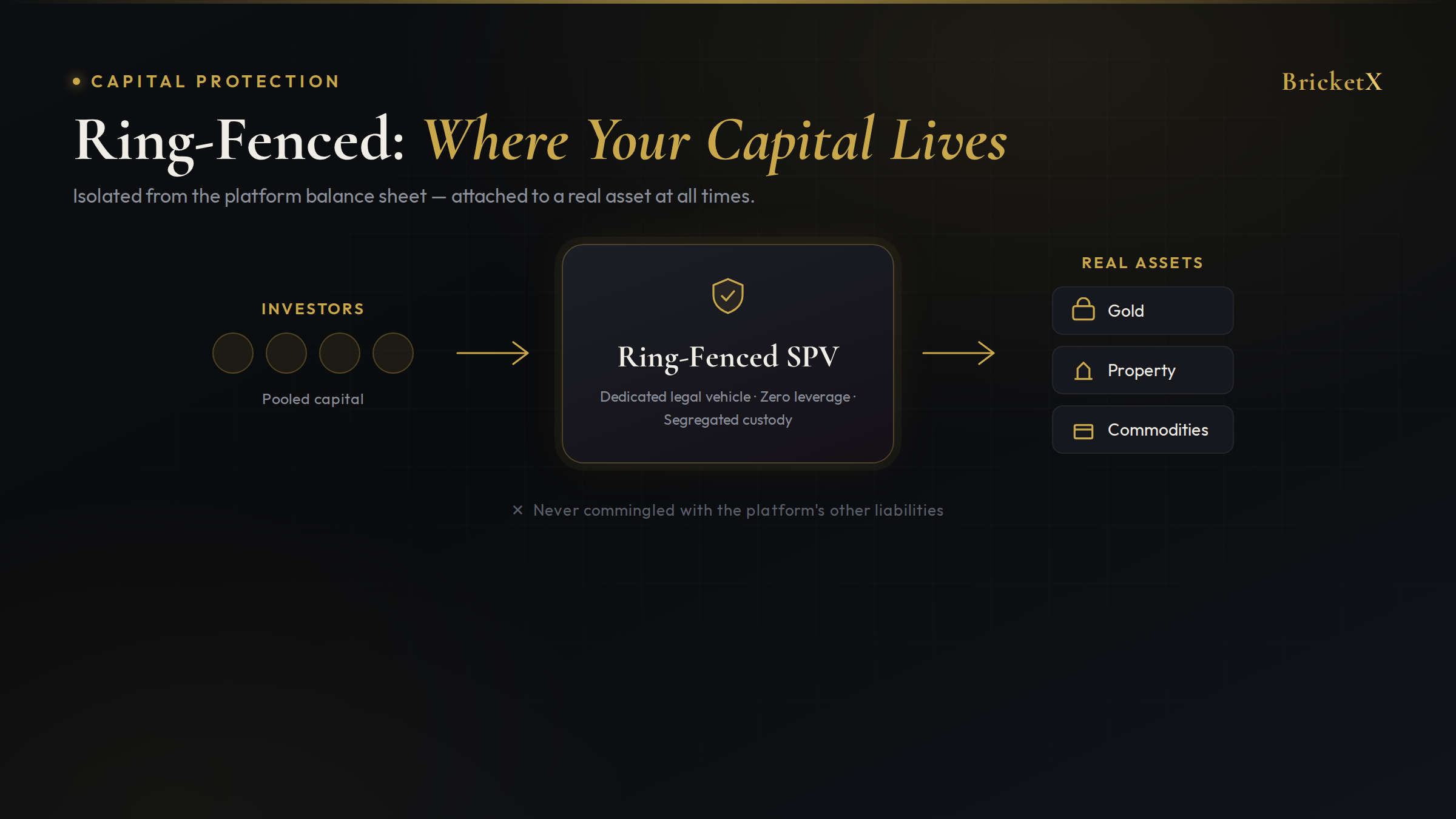
Steps 3 and 4 above are where most of the risk in this entire category is decided. Two platforms can advertise identical returns, but if one holds your capital inside a ring-fenced SPV and the other holds it on its own balance sheet, you are in two completely different risk positions. Here is the structural layer, unpacked.
Ring-Fenced SPV
A separate legal entity holds the assets for one vertical. If trouble hits elsewhere in the business, creditors cannot reach into the SPV - your capital is isolated from the platform's other liabilities.
Zero Leverage
Your capital isn't borrowed against or amplified with hidden debt. Leverage magnifies losses as much as gains - a properly structured platform deploys real capital into real operations without gearing it up.
Segregated Custody
Investor funds are held separately from operating cash, so the money committed to your operation cannot quietly fund the platform's payroll, marketing, or unrelated ventures.
Independent Audit
Third-party auditors verify that the operations and returns are real. This converts "trust us" into "check for yourself" - the difference between a claim and a credential.
Defined Tenure
Capital is locked for a set term matched to the operation's cycle. You know the exit date up front - there are no surprise gates or indefinite freezes on withdrawal.
Named Operations
You can see the actual verticals, corridors, and entities your capital funds - not an anonymous "strategy." Transparency about where money goes is itself a protection.
Together these six elements form what a serious platform means by "capital protection." None of them is exotic - they are the same protections pension funds and family offices have demanded for decades. What has changed is that platforms now make the same structures accessible to qualified individual investors. You can read the full protection framework on the Trust & Security page.
"The return is what a platform advertises. The structure is what determines whether you ever see it."
- BricketX Editorial
See the Structure Before You Commit
Six asset-backed packages, each built on a ring-fenced SPV with a 70/30 profit split and independent auditing. Explore exactly how your capital would be deployed.
How Returns Actually Reach You
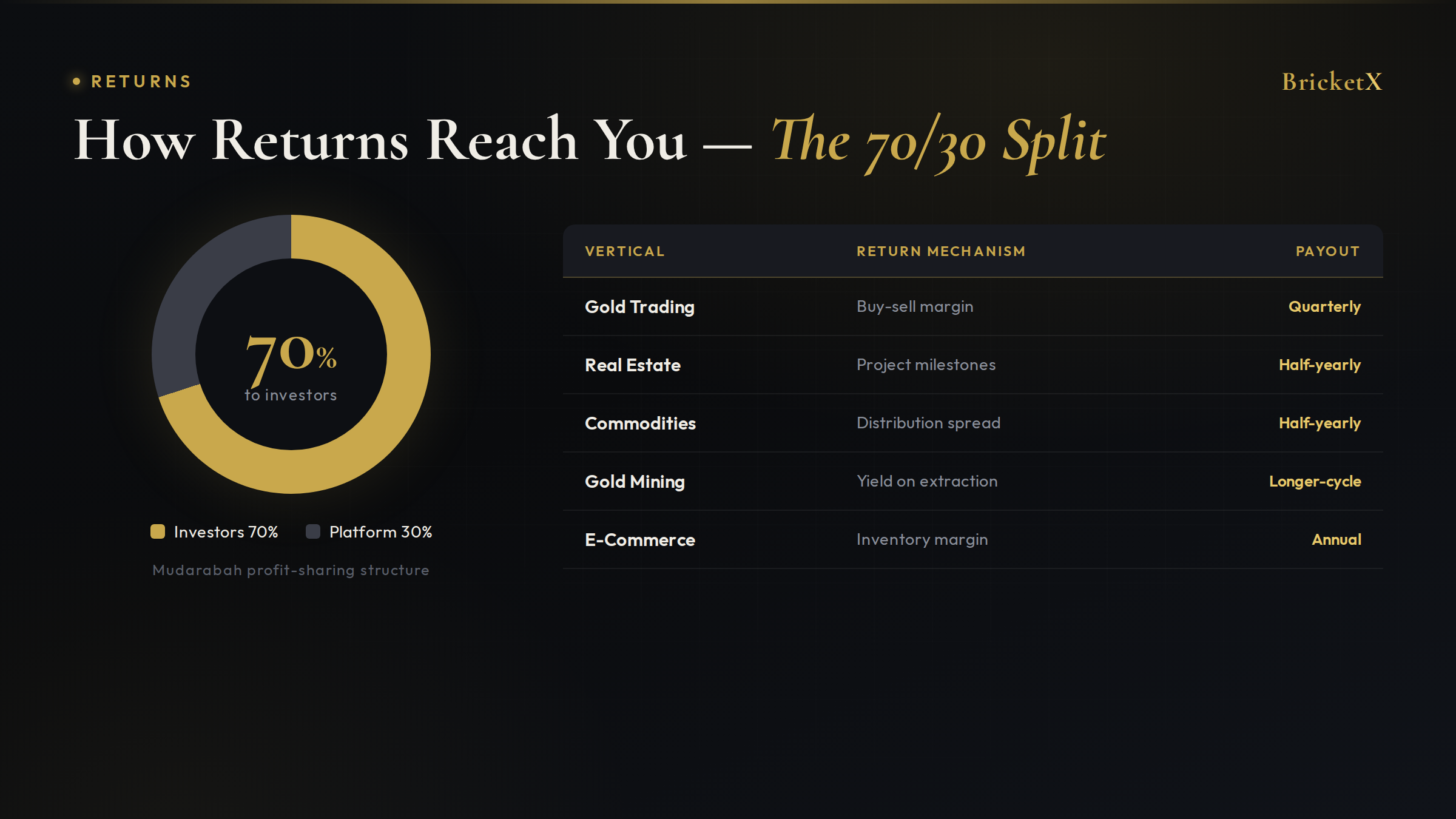
One of the most common points of confusion is when and how an asset-backed platform pays. It does not work like a stock, where the price ticks every second and you can sell any afternoon. It works like a business that completes a cycle, banks a profit, and shares it out. Payout timing is tied to how long each operation takes to complete.
| Vertical | Return Mechanism | Typical Payout Cycle |
|---|---|---|
| Gold Trading | Buy-sell margin on physical gold along active corridors | Quarterly |
| Real Estate Development | Project profit realised at construction milestones | Half-yearly |
| Commodities | Procurement-to-distribution spread on physical goods | Half-yearly |
| Gold Mining | Yield from extracted, refined, and sold gold | Longer-cycle |
| E-Commerce | Margin between inventory cost and retail sale price | Annual |
Notice the pattern: faster operations pay more frequently. Gold trading turns over inventory in weeks, so it can distribute quarterly. A real estate development takes months to hit a milestone, so it pays half-yearly. This is why investors who want smoother income across the year often combine verticals - either through separate package positions or a single multi-asset fund that blends the payout calendars.
On the split itself: your operational profit is shared with the platform on a fixed basis, disclosed before you invest. At BricketX that is 70% to you and 30% to the platform under a Mudarabah structure - a profit-and-loss-sharing arrangement rather than a fixed interest rate. If you want the theological and structural detail behind that, the Shariah-compliant investment page covers it.
Legitimate Platform vs Poorly Structured Platform
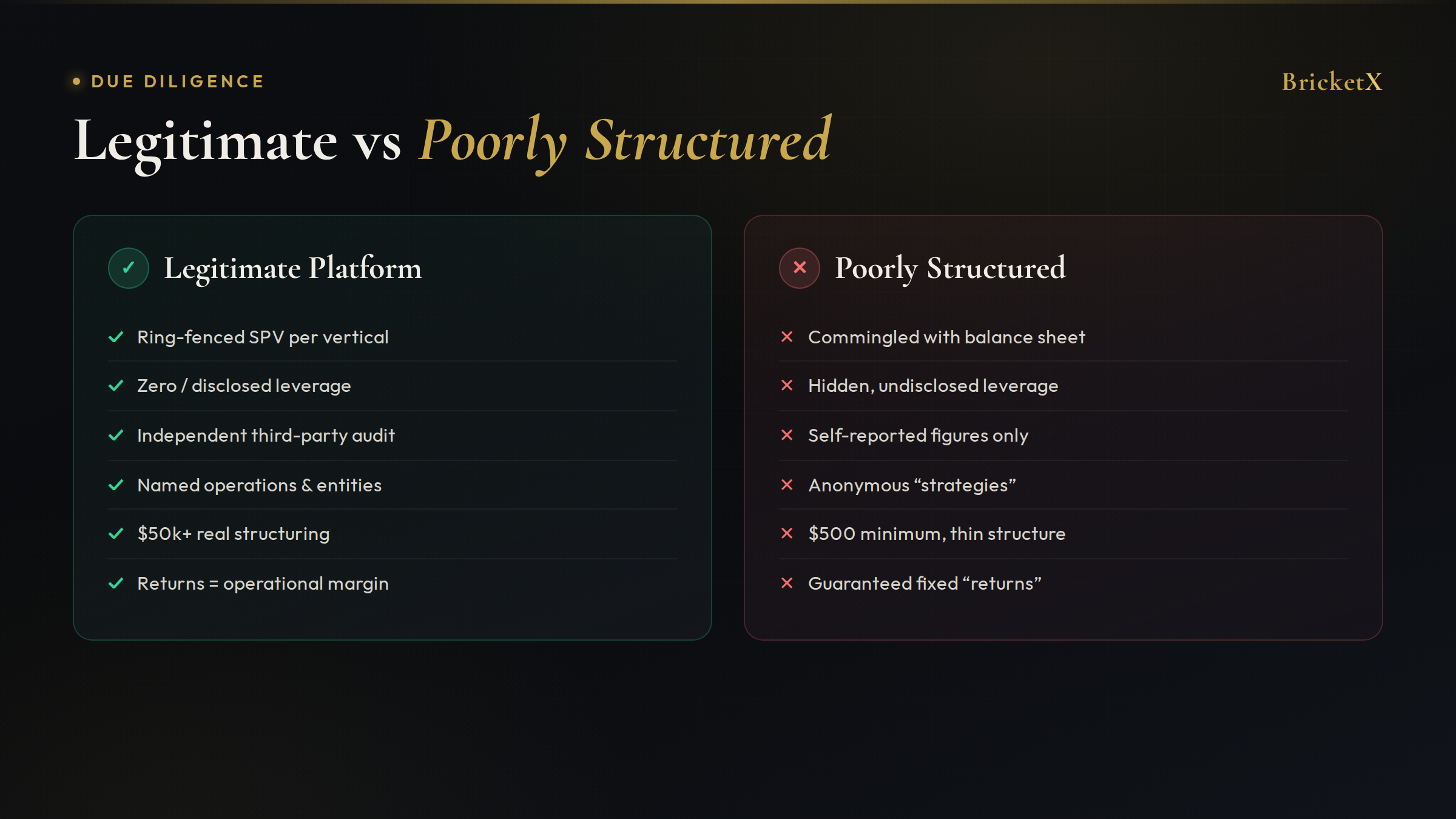
This is the section that matters most for protecting your capital. Two platforms can look identical on a landing page - the same words, the same gold accents, the same promised returns. The differences live in the structure, and they are entirely knowable before you invest. Use this table as a checklist.
| Factor | Legitimate Platform | Poorly Structured Platform |
|---|---|---|
| Capital structure | Ring-fenced SPV per vertical | Commingled with company balance sheet |
| Leverage | Zero, or clearly disclosed | Undisclosed debt against your capital |
| Return framing | Operational margin, variable | Guaranteed high fixed rate, unexplained |
| Auditing | Independent third-party audits | Self-reported figures only |
| Minimum investment | $50k+ (reflects real structuring cost) | $500 (structure too thin to protect) |
| Transparency | Named operations, corridors, entities | Anonymous "strategies," no detail |
| Legal footprint | Verifiable licensed entities | No identifiable regulated entity |
The minimum-investment line surprises people, so it's worth explaining. A very low minimum sounds investor-friendly, but the legal structuring, SPV administration, compliance, and auditing that make an asset-backed investment safe cost real money to maintain. Below a certain threshold, those protections simply are not economically viable - so a platform advertising "asset-backed" products at a $500 minimum is usually skipping the very structures that would justify the label.
Red flags that should stop you
If a platform shows any of these, treat it as a reason to walk away until it is explained to your satisfaction:
- Guaranteed fixed returns with no explanation of the operation generating them - real operations vary; guarantees on "asset-backed" returns are a contradiction.
- No named SPV or legal entity standing behind your capital.
- No independent audit - only figures the platform reports about itself.
- Vagueness about where the money actually goes or what the assets are.
- Pressure to invest fast, limited-time bonuses, or aggressive referral rewards.
- Returns that appear to be paid from new deposits rather than operations - the signature of a Ponzi structure.
A useful test: ask the platform to name the specific entity holding your capital and the specific operation it funds. A legitimate platform answers in one sentence. A poorly structured one deflects - and the deflection is your answer.
How BricketX Structures the Process
BricketX runs the full eight-step lifecycle above across five real-asset verticals, each held inside its own ring-fenced SPV. Here is the model in plain terms:
Five verticals, one framework
Gold trading, real estate development & contracting, gold mining, commodities, and e-commerce - each with its own operations, corridor, and payout cycle, all sitting under the same structural protections.
Ring-fenced SPVs and zero leverage
Your capital is isolated per vertical and never geared up with hidden debt. See the SPV structure in detail.
70/30 Mudarabah split
A profit-and-loss-sharing arrangement, disclosed before you commit, rather than a fixed promised rate.
Independent auditing and named operations
Real corridors - such as the Kenya-to-Dubai gold trade - real entities, and third-party verification.
$50,000 minimum across six packages
A threshold set to fund genuine structuring, from a one-year Bronze position to a five-year Premium tenure.
Dubai-headquartered, Shariah-compliant
Operating across Dubai and Kenya with verifiable licensed entities.
If you want to see the whole process end to end - including how KYC, deployment, and payout connect - the How It Works page walks through it, and the investments overview shows each vertical's mechanics individually.
Frequently Asked Questions
How do asset-backed investment platforms work?
What is the step-by-step process of investing through one?
How do I know if an asset-backed platform is legitimate?
Where does my money go when I invest?
How and when do these platforms pay returns?
What is the minimum to invest through an asset-backed platform?
Related Pages
Keep Reading
This article is produced by BricketX Investments for informational and educational purposes only. It does not constitute financial advice, an offer to sell, or a solicitation to buy any investment product. Asset-backed investments carry operational, liquidity, concentration, and platform risks. Capital committed is subject to defined tenure lock-in. Past operational performance does not guarantee future results. Prospective investors should conduct their own due diligence and consult a qualified financial adviser.
More from the BricketX Blog
Is Gold a Safe Investment Asset in 2026? What HNWIs Need to Know
Gold is a safe haven, not a risk-free asset. Here is what high-net-worth investors need to know in 2026 before allocating.
Asset-Backed vs Stock Market: Which Investment Protects Capital Better?
A downturn is the only honest test of an investment. Here's a direct comparison of how asset-backed investments and the stock market each protect your capital, and where the real trade-offs lie.
Investing in Construction Projects Globally: A Guide for International Investors
You don't need a local company or a lawyer in three jurisdictions to put capital into a construction project abroad - but you do need to know exactly what stands between you and that project first.