Investing in Construction Projects Globally: A Guide for International Investors
You don't need a local company or a lawyer in three jurisdictions to put capital into a construction project abroad - but you do need to know exactly what stands between you and that project first.
You don't need a local company, a lawyer in three jurisdictions, or a reason to fly out and inspect a site to put capital into a construction project abroad - but you do need to know exactly what stands between you and that project before you wire anything. Here's how international investors actually do this, the routes available, and what to check before committing capital across a border.
The Short Answer: How International Investors Invest in Construction Projects
International investors put capital into construction projects abroad through one of four routes - a direct joint venture with a local developer, shares in a listed REIT, a crowdfunding platform, or an asset-backed investment platform that pools capital into a ring-fenced SPV tied to a specific project. For an investor without local legal presence, the asset-backed route is generally the most accessible: KYC, currency handling, and construction-phase capital deployment are managed through a single onboarding process, without requiring local company registration or an on-the-ground presence.
The core problem international investors actually face isn't finding a construction project - it's finding one they can get capital into and out of without a local lawyer, a currency headache, or blind trust in a website. This guide covers the real access routes, what separates a safe cross-border structure from a risky one, and the actual step-by-step process.
Why Investors Look Beyond Their Own Market
Construction and development returns are tied to local land costs, labour costs, and demand - all of which vary enormously by country. An investor based in one market often finds that development margins, project pipelines, or growth corridors are simply more attractive somewhere else, particularly in fast-growing regions where construction activity is outpacing the domestic capital available to fund it.
Diversification
A construction project in another country is exposed to a different local economy, currency, and regulatory cycle than a domestic portfolio - genuine diversification, not just a different building.
Access to Growth Corridors
Some markets have construction demand and development margins that simply outpace what's available at home - access that direct property ownership abroad rarely makes practical.
Dollar-Denominated Access
A well-structured platform lets you hold USD-denominated exposure to a local construction market, without personally managing a foreign bank account or currency conversion.
The Real Challenge: What Actually Stands Between You and the Project
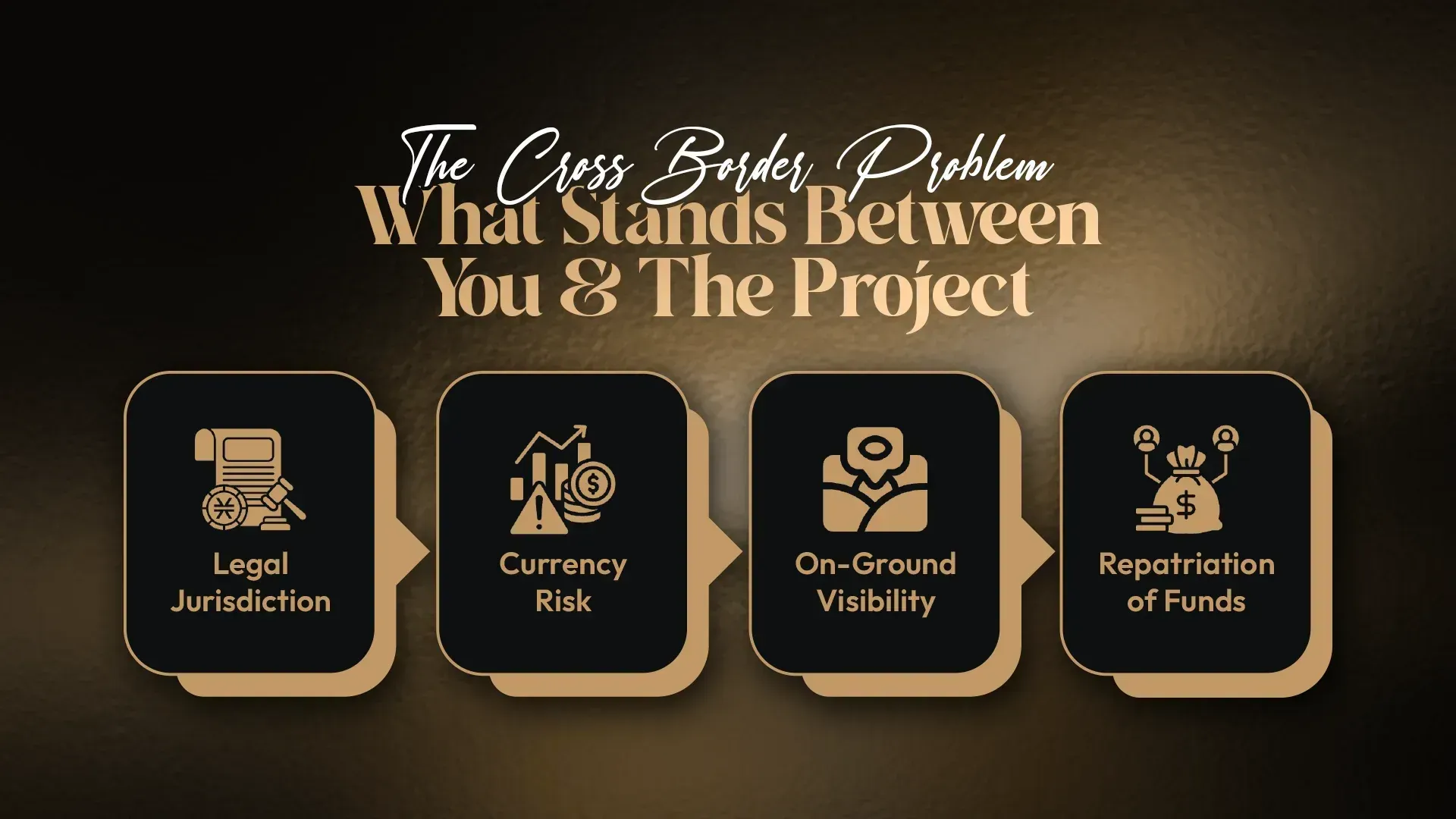
This is where most international investors get stuck, and it's rarely the investment thesis - it's the mechanics of the border itself:
- Legal jurisdiction. Property and construction law is local. An investor abroad typically has no practical way to independently verify title, permitting, or contractor agreements in a country they've never worked in.
- Currency risk. A project priced and sold in a local currency exposes a foreign investor to exchange-rate movement on top of the project's own risk - often an unpriced, unmanaged variable.
- On-the-ground visibility. You can't inspect a construction site from another continent. Someone has to be the eyes on the project, and that someone's incentives matter enormously.
- Repatriation of funds. Getting capital and profit out of a country can be more complicated than getting it in, depending on local capital controls and banking relationships.
None of these are reasons to avoid investing abroad - they're the specific things a good structure needs to solve, which is exactly what the rest of this guide walks through.
The Four Ways International Investors Actually Access Construction Projects
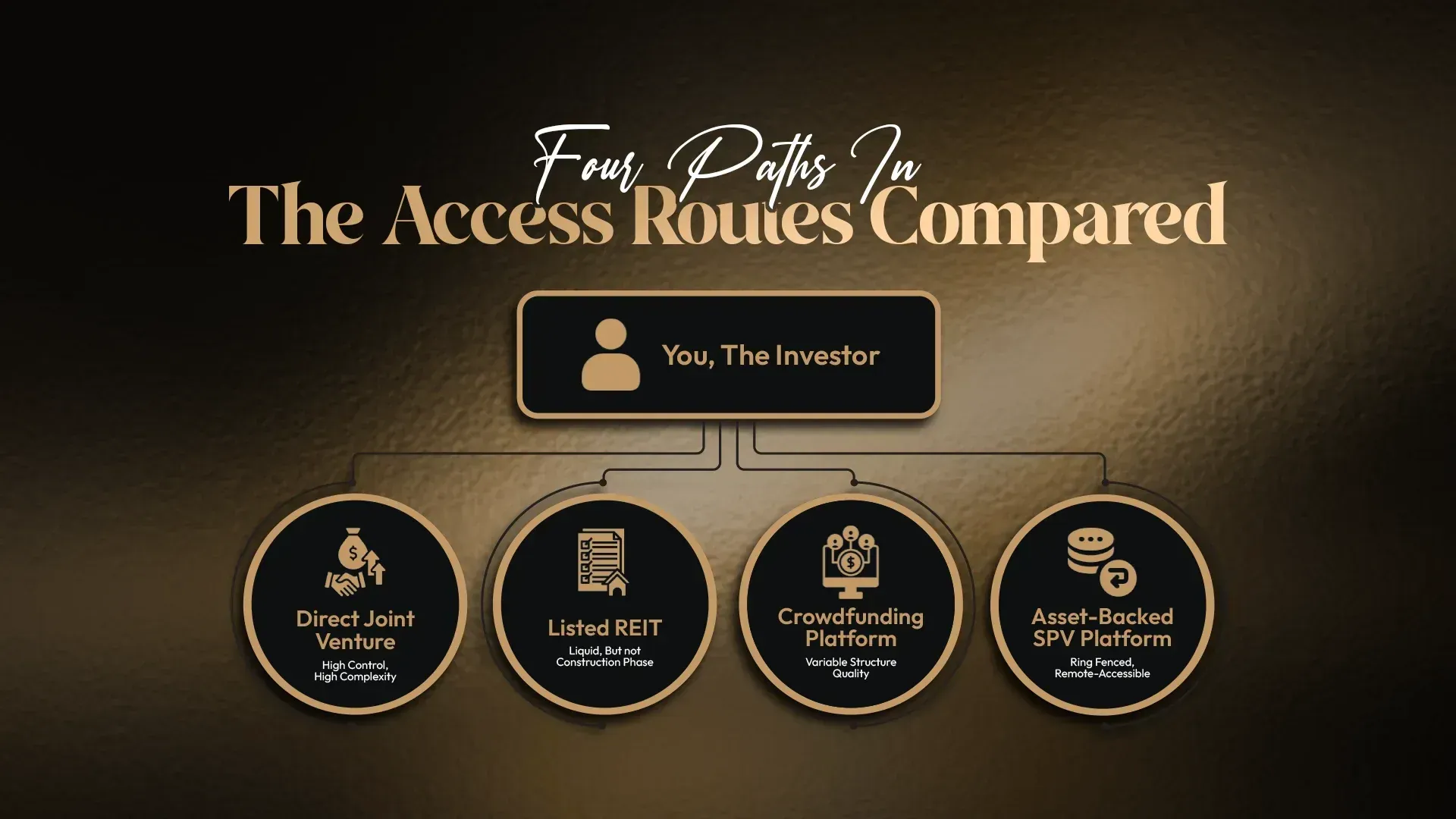
Direct joint venture with a local developer
Maximum control, but requires local legal counsel, a direct relationship with the developer, and typically a much larger capital commitment. Practical mainly for institutional investors or family offices with local partners already in place.
Shares in a listed REIT
Fully liquid and simple to access from anywhere, but you're buying exposure to a portfolio of completed buildings, not the construction phase itself, and the share price carries stock-market sentiment alongside property fundamentals.
Real estate crowdfunding platforms
Lower minimums and easier onboarding than a direct JV, but structure quality varies widely - some ring-fence capital per project properly, others pool it into less transparent vehicles.
Asset-backed investment platforms
Capital is pooled into a ring-fenced SPV tied to a specific construction project. KYC, currency, and reporting are handled through the platform, letting an investor abroad participate in the construction phase itself without local legal presence.
Invest in Construction Projects From Anywhere
Ring-fenced SPV per project, USD-denominated, remote KYC, milestone-based construction financing, from $50,000.
Comparing the Four Routes
| Route | Control | Minimum Capital | Liquidity | Legal Complexity for You |
|---|---|---|---|---|
| Direct Joint Venture | Highest | Very high | Very low | High, local counsel needed |
| Listed REIT | Low | Low | Daily | Low |
| Crowdfunding Platform | Low | Low-moderate | Low | Variable by platform |
| Asset-Backed Platform (SPV) | Moderate | Moderate | Defined tenure | Low, handled by structure |
For a deeper look at how the construction phase itself is financed once capital is deployed, see our guide on real estate development investment and what returns to expect.
How BricketX Is Built for the International Investor Specifically
The structure that makes a construction investment accessible from abroad is the same structure that makes it safer for anyone - it just matters more when you can't inspect the site yourself.
Ring-Fenced SPV Per Project
Your capital is tied to a specific development, isolated from the platform's other liabilities - the same structure regardless of where you're investing from.
Remote, Single-Process KYC
Identity verification and onboarding happen online, once, regardless of your country of residence - no local registration required.
USD-Denominated
Investments are held and reported in US dollars, removing the local-currency exposure of the physical construction market underneath.
Milestone-Verified Construction
Independent quantity surveyors and valuers verify progress on your behalf - the on-the-ground visibility you can't provide yourself.
Verified Title & Permitting
Land title and permits are checked before acquisition, standing in for the local legal due diligence a foreign investor can't easily perform alone.
Shariah-Compliant Structure
The 70/30 Mudarabah profit-share applies uniformly, wherever you're investing from - the same terms, not a jurisdiction-by-jurisdiction variation.
The full mechanics of onboarding and deployment are covered in How It Works, and the complete protection framework is on Trust & Security.
Before You Wire Anything: A Cross-Border Due-Diligence Checklist
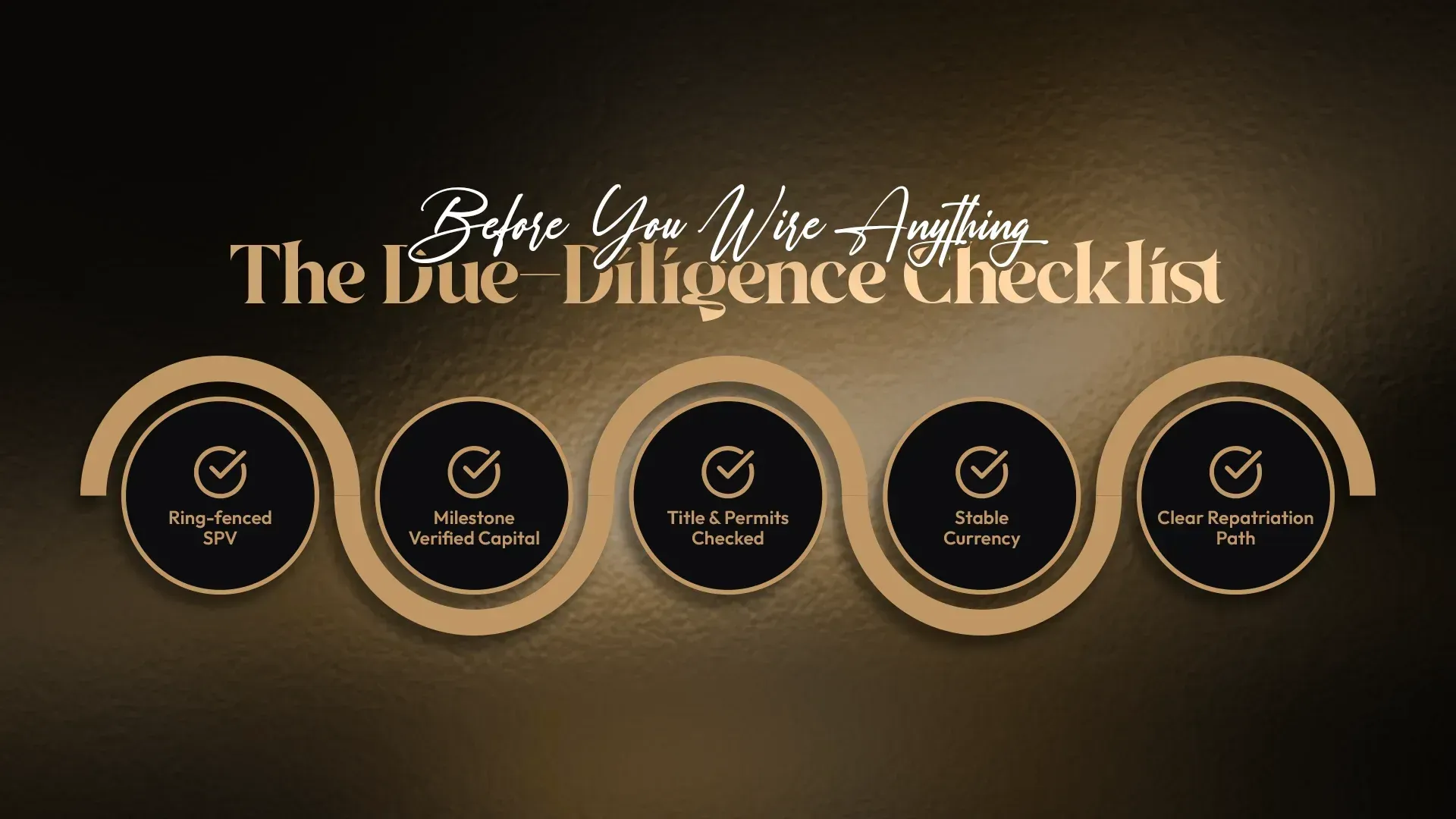
Whichever platform or structure you're considering, confirm these before committing capital to a construction project you can't personally visit:
Capital sits in a ring-fenced SPV tied to a specific project, not the platform's general balance sheet.
Construction capital is released in phases against independently verified milestones, never as a lump sum.
Land title and permitting were verified before acquisition, with documentation available on request.
The investment is denominated in a stable, disclosed currency, not left ambiguous between your currency and the local one.
There's a clear, defined process for how profit and capital are returned to you internationally, with no undisclosed repatriation steps.
Reported figures are independently audited, not just self-reported by the platform.
Contact and support are genuinely accessible across your time zone, not a single local office with no remote channel.
Red flag for any cross-border deal: if you cannot get a straight answer on which entity legally holds the project, in which jurisdiction, and how funds move between that entity and you, that is a structural gap, not a detail to sort out later.
Risks Specific to International Investors
Beyond the standard construction risks - cost overruns, delays, and exit-market conditions - cross-border investors carry a few additional ones worth naming directly:
- Currency conversion risk. Even a USD-denominated investment involves converting from your home currency going in and, eventually, coming out - movement in that rate is a real, separate variable.
- Jurisdictional risk. Legal recourse, if anything ever goes wrong, runs through the structure's jurisdiction - understanding which one that is matters before you invest, not after.
- Communication and time-zone risk. A platform with no accessible support in your hours effectively leaves you uninformed for long stretches.
- Concentration risk. A single project in a single country carries that country's specific economic and political conditions - diversifying across projects or verticals reduces this.
Investors managing these risks often spread capital across a multi-asset fund rather than a single project, and pair construction exposure with other real-asset verticals like gold trading or commodities.
The Step-by-Step Process for International Investors
Choose a ring-fenced structure over a direct local purchase
This avoids needing local company registration or property law expertise altogether.
Complete KYC remotely
Standard identity and source-of-funds verification, done entirely online.
Fund the investment via international wire, in USD
Minimum $50,000 across BricketX's packages.
Select a package and tenure
Matched to the construction project's realistic build-to-exit timeline - one to five years, Bronze through Premium.
Track milestone-based deployment
As capital moves through land acquisition, permitting, and phased construction.
Receive payouts and capital return
Through the same verified channel used to fund the investment - half-yearly for the real estate development vertical.
"Distance from a construction site isn't the risk. Not knowing exactly which structure stands between you and it is."
- BricketX Editorial Team
Full details on tenures and minimums are on the investment packages page, and the construction-financing mechanics specifically are covered in Real Estate Development Investment: How It Works and What Returns to Expect.
Frequently Asked Questions
How can international investors invest in construction projects?
Do I need to live in the country where the construction project is located?
Is investing in construction projects abroad safe for foreign investors?
What currency are international construction investments usually denominated in?
What should I check before investing in a construction project in another country?
What is the minimum amount to invest in construction projects as a foreign investor?
This article is for informational and educational purposes only and does not constitute financial, legal, or tax advice, an offer to sell, or a solicitation to buy any investment product. International investors should independently confirm the tax and regulatory treatment of any cross-border investment in their own country of residence, as this varies by jurisdiction and is not addressed by this article. Cross-border construction investments carry currency, jurisdictional, execution, exit-market, liquidity, and concentration risks. Capital committed is subject to defined tenure lock-in. Past performance does not guarantee future results. Returns stated are targets, not guarantees. KYC/AML verification is required for all investment participation. Prospective investors should conduct their own due diligence and consult a qualified financial and legal adviser.
More from the BricketX Blog
Is Gold a Safe Investment Asset in 2026? What HNWIs Need to Know
Gold is a safe haven, not a risk-free asset. Here is what high-net-worth investors need to know in 2026 before allocating.
Asset-Backed vs Stock Market: Which Investment Protects Capital Better?
A downturn is the only honest test of an investment. Here's a direct comparison of how asset-backed investments and the stock market each protect your capital, and where the real trade-offs lie.
Safe Asset-Backed Investments During Inflation: What Actually Works in 2026
Cash and bonds lose to inflation by design. Here's what the 2026 data actually shows works instead -real assets, asset-backed structures, and how to tell a genuine inflation hedge from one that only wears the label.