Asset-Backed Gold Investment: How BricketX Deploys Capital Through the Kenya–Dubai Gold Corridor
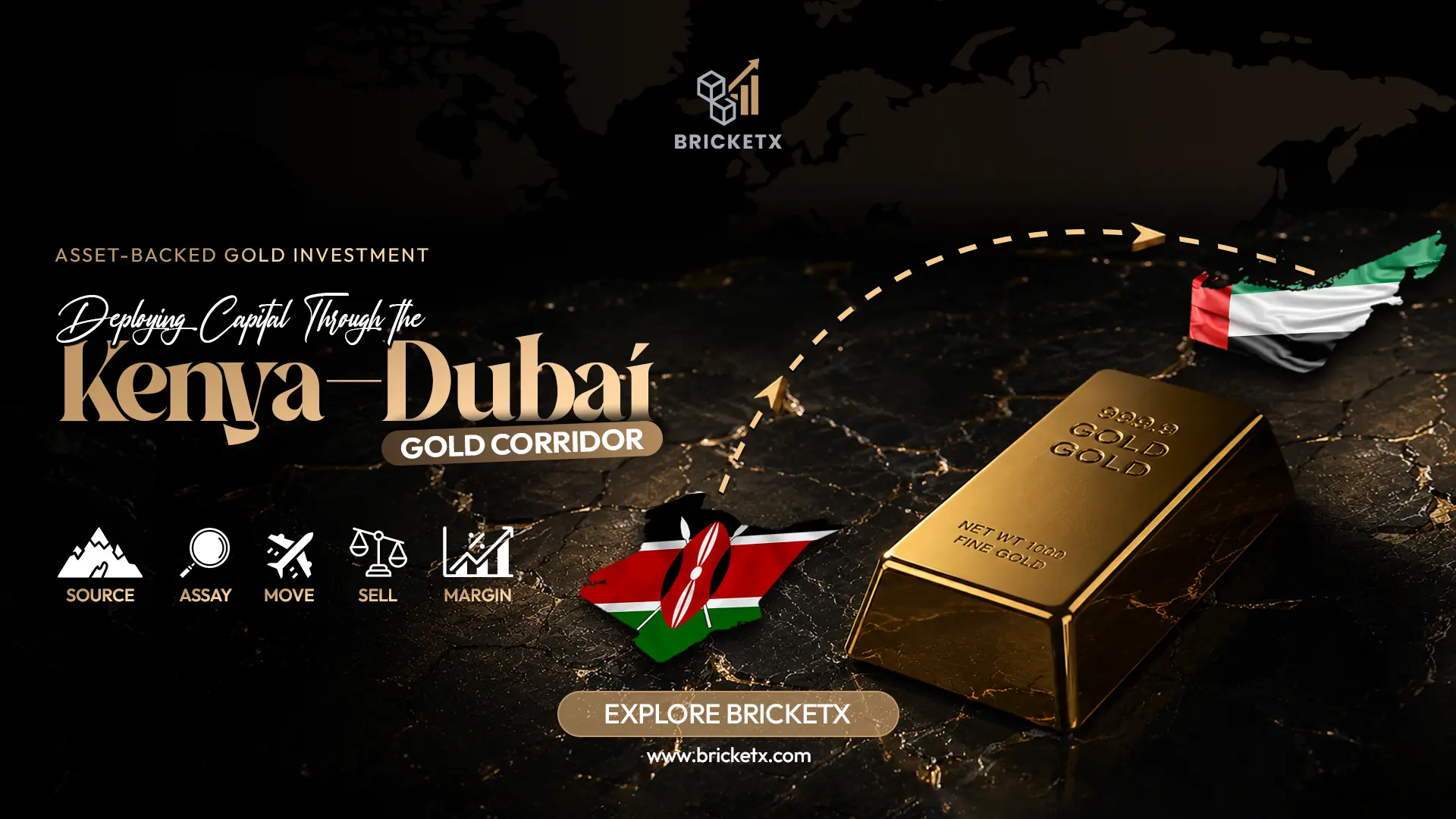
A deep dive into asset-backed gold investment -how BricketX deploys investor capital along the Kenya–Dubai gold corridor, where the trading margin comes from, how the SPV structure protects capital, and how it differs from buying physical gold or a gold ETF.
Most gold investors own a metal that just sits there -waiting for a price move that may never come. BricketX takes a different route, literally. This is a deep dive into how investor capital is deployed into physical gold along the Kenya–Dubai corridor, where the return actually comes from, and why moving gold can pay even when the gold price does not.
The Short Answer: What Is Asset-Backed Gold Investment?
An asset-backed gold investment deploys your capital into physical gold operations -procuring, moving, and selling real gold along a trade corridor -rather than into a paper claim like a gold ETF. The return comes from the operational trading margin (the spread between the buying and selling price), not from betting that the gold spot price will rise. At every stage, physical gold secures the position.
When most people "invest in gold," they buy the metal and wait. Their entire return depends on one thing: the spot price being higher when they sell than when they bought. That is price speculation, and it can sit flat for years.
A corridor-based gold trading investment works differently. Instead of holding gold and hoping, it puts capital to work moving gold -buying it where it is cheaper at origin, and selling it where it commands more in a major marketplace. The difference between those two prices, net of costs, is the return. That is an operational margin, and it can be generated whether or not the gold price is climbing. This is the mechanism behind BricketX's gold trading investment vertical, and the route it runs is the Kenya–Dubai corridor.
Why the Kenya–Dubai Corridor?
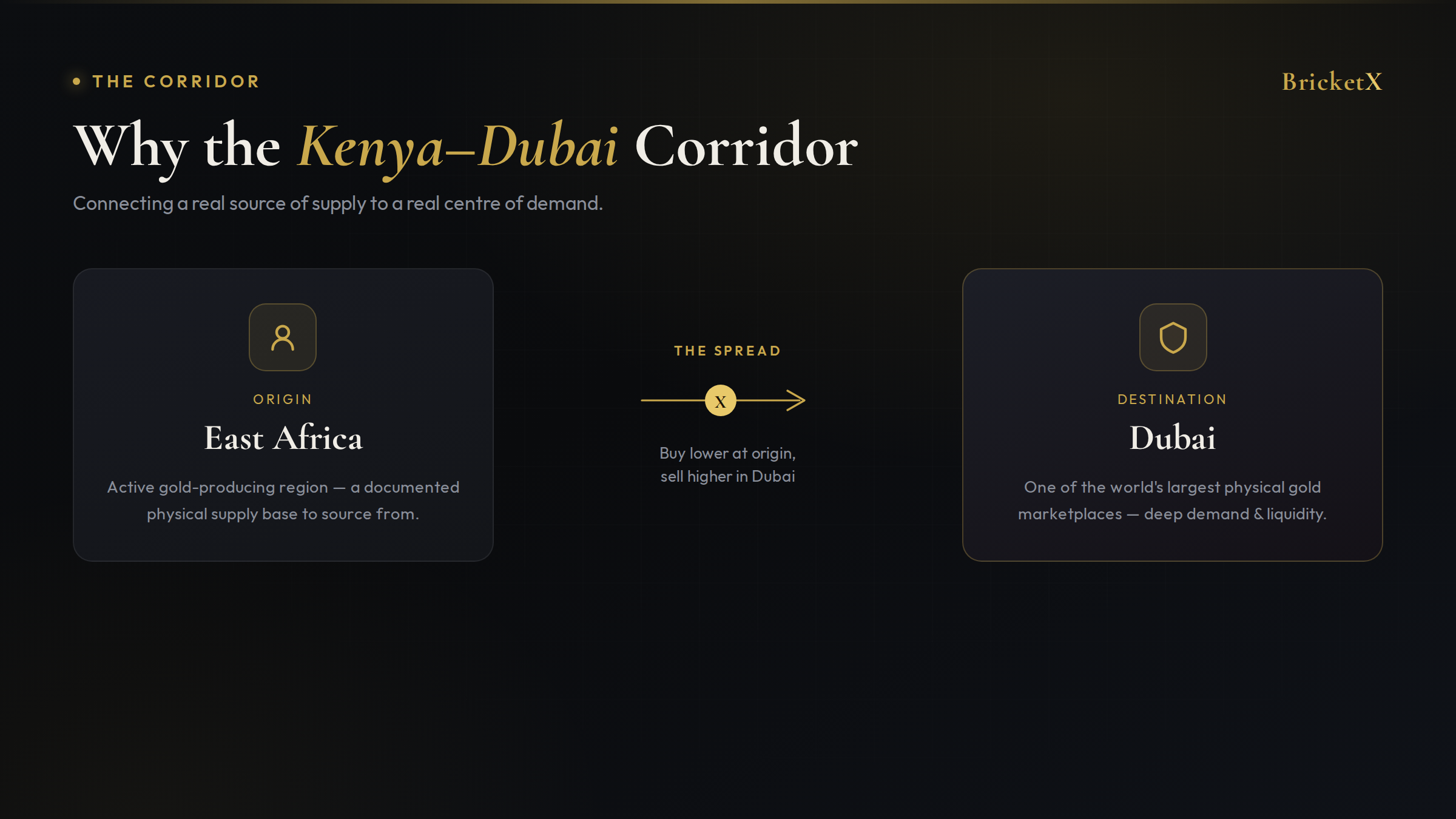
A trade corridor only works if it connects a genuine source of supply to a genuine centre of demand. The Kenya–Dubai route does exactly that.
Origin: East Africa
Kenya and the wider East-African region are an active gold-producing area, giving the corridor a real, documented physical supply base to source from.
Destination: Dubai
Dubai is one of the world's largest physical gold marketplaces, with deep institutional demand, refining capacity, and liquidity -a place where verified gold sells reliably.
The Spread
Because origin pricing and Dubai marketplace pricing differ, moving verified gold from one to the other creates a repeatable operational margin -the engine of the return.
Put simply: the corridor exists because gold is worth sourcing in one place and selling in another, and the gap between those two prices -after logistics, refining, and operating costs -is real. BricketX's role is to deploy capital into that gap safely, repeatedly, and with the physical metal accounted for at every step.
The core idea: you are not betting on gold going up. You are investing in the business of moving gold from where it is cheaper to where it sells for more -a margin that exists in flat markets too.
How BricketX Deploys Capital Along the Corridor
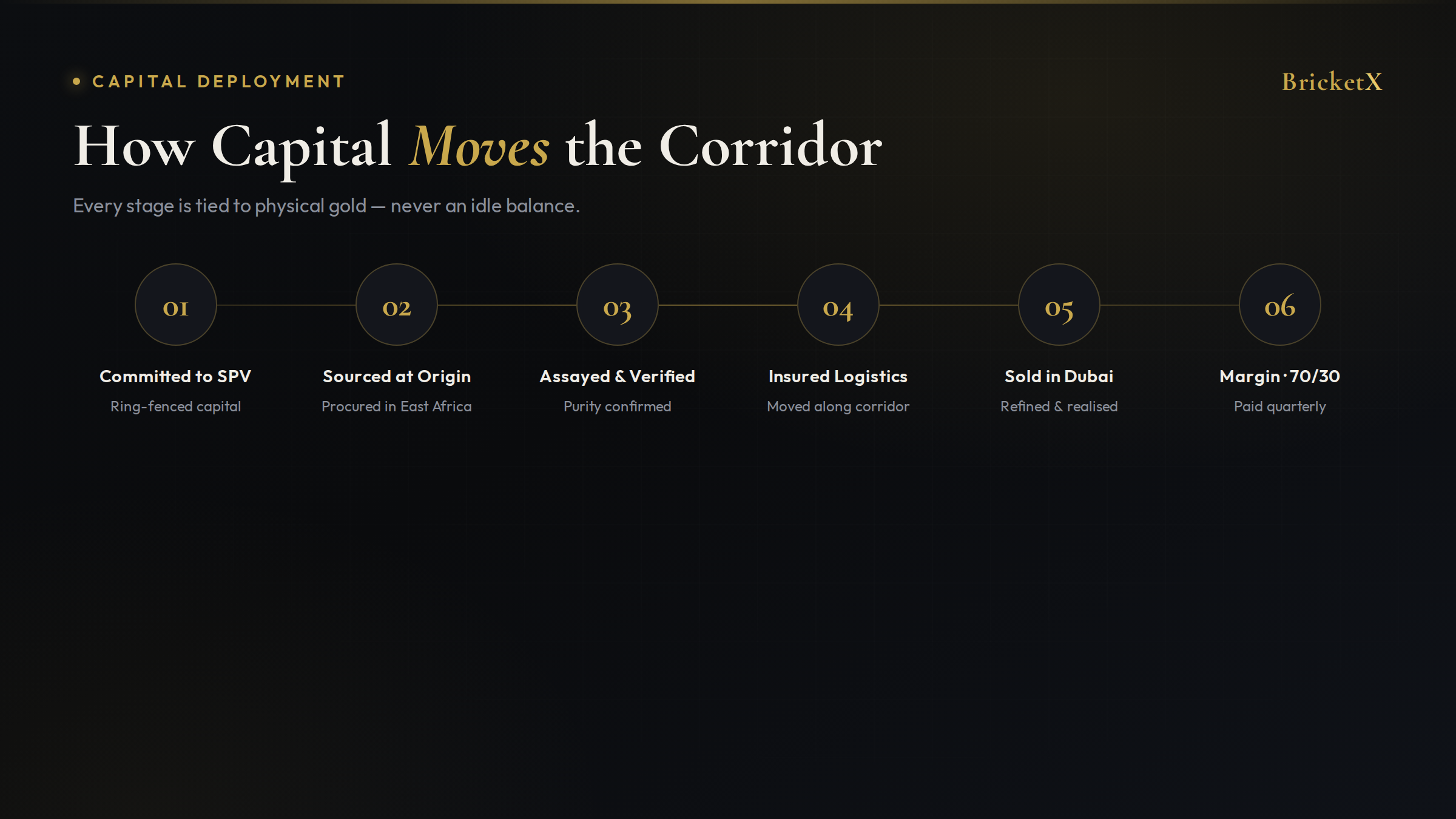
Here is the operational sequence a unit of capital follows once you invest into the gold trading vertical. Each stage is where your money is at a given moment -and each one is tied to physical gold or a documented process, never left as an idle balance.
Capital committed to a ring-fenced SPV
Investor capital is pooled into a dedicated Special Purpose Vehicle created for the gold trading vertical, isolating it from unrelated activity and from the platform's own balance sheet.
Sourcing & procurement at origin
The operations team procures physical gold at the East-African origin point through vetted, documented supply relationships -the point where the corridor's cost advantage begins.
Assay & verification
Every parcel is weighed and assayed for purity, then documented. Only verified physical gold enters the trade -the step that protects capital from mispriced or misrepresented metal.
Insured logistics & export
The verified gold is transported along the corridor under insured, compliant logistics. Insurance and compliance here are not overhead -they are what keep the position protected while it is in transit.
Refining & sale in Dubai
In Dubai, the gold is refined as required and sold to institutional buyers in a deep, liquid marketplace -the point where the corridor's value is realised.
Margin is realised, profit distributed
The return is the buy-sell margin -the Dubai sale price minus the origin cost and operating expenses. Realised profit is split 70% to investors, 30% to the platform under a Mudarabah structure, paid quarterly, and capital is redeployed into the next trade until tenure end.
"The gold never just sits. At every moment it is being sourced, verified, moved, or sold -and your capital is doing the same."
-BricketX Editorial
Invest in the Gold Trading Vertical
Physical gold, sourced and sold along the Kenya–Dubai corridor. Ring-fenced SPV, 70/30 split, quarterly payouts, from $50,000.
Where the Margin Actually Comes From
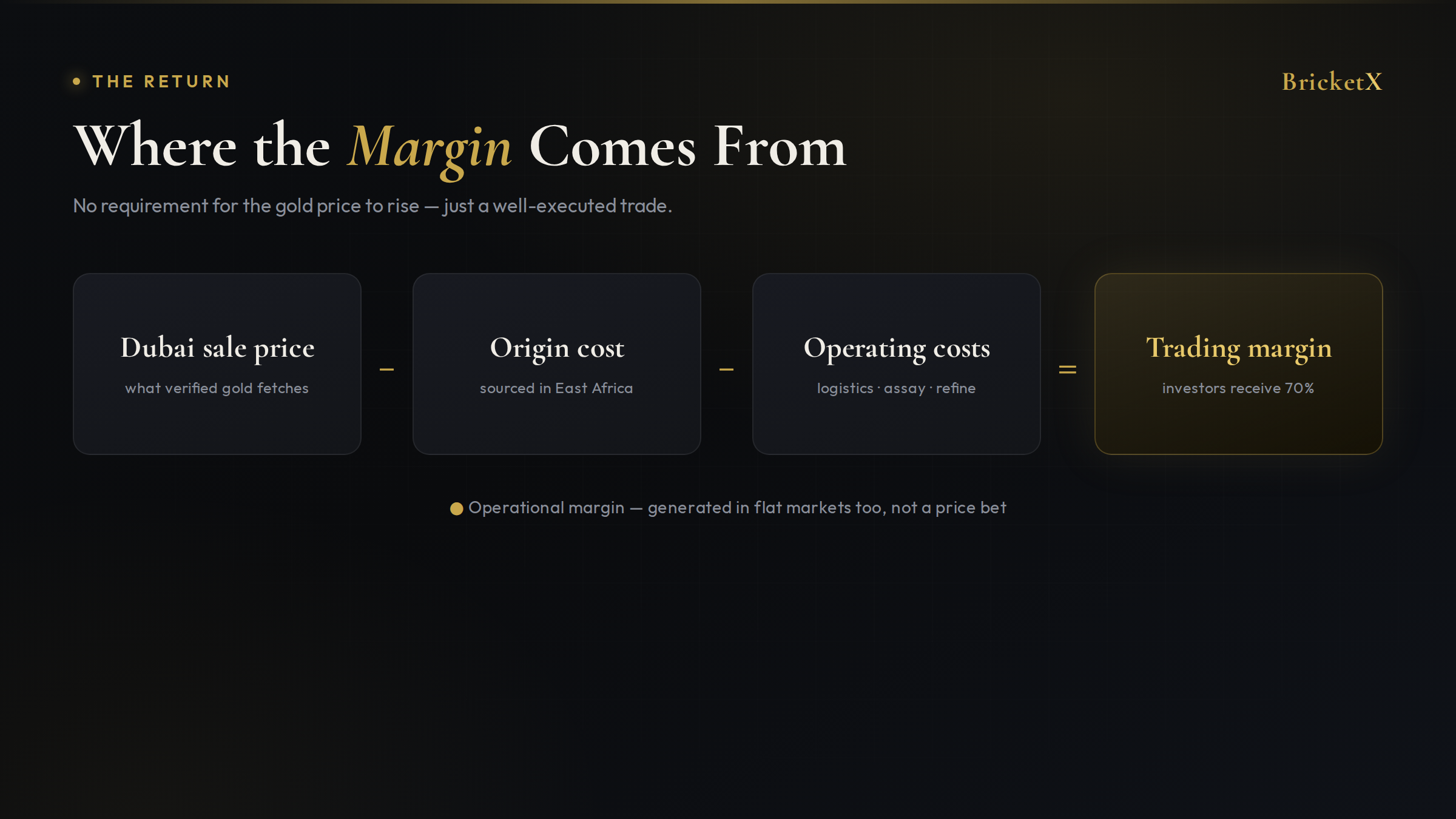
It is worth being precise about the return, because this is exactly what separates corridor trading from price speculation. The margin is built from a simple equation:
- Sale price in Dubai -what verified gold fetches in a deep, institutional marketplace.
- minus procurement cost at origin -what the same gold was sourced for in East Africa.
- minus operating costs -logistics, insurance, refining, assay, and compliance.
- = the operational trading margin, of which investors receive 70%.
Notice what is not in that equation: a requirement for the gold price to rise. Because the metal is bought and sold within a relatively short cycle, the trade captures the spread rather than a long-term price bet. That is why gold trading, of all BricketX's verticals, pays on the most frequent cadence -the operation completes and recycles quickly.
Price movement isn't irrelevant -sharp swings while gold is in transit are a genuine risk (covered below) -but the design of the return is operational. You are being paid for executing a physical trade well, not for guessing the market.
Corridor Trading vs Buying Gold vs a Gold ETF
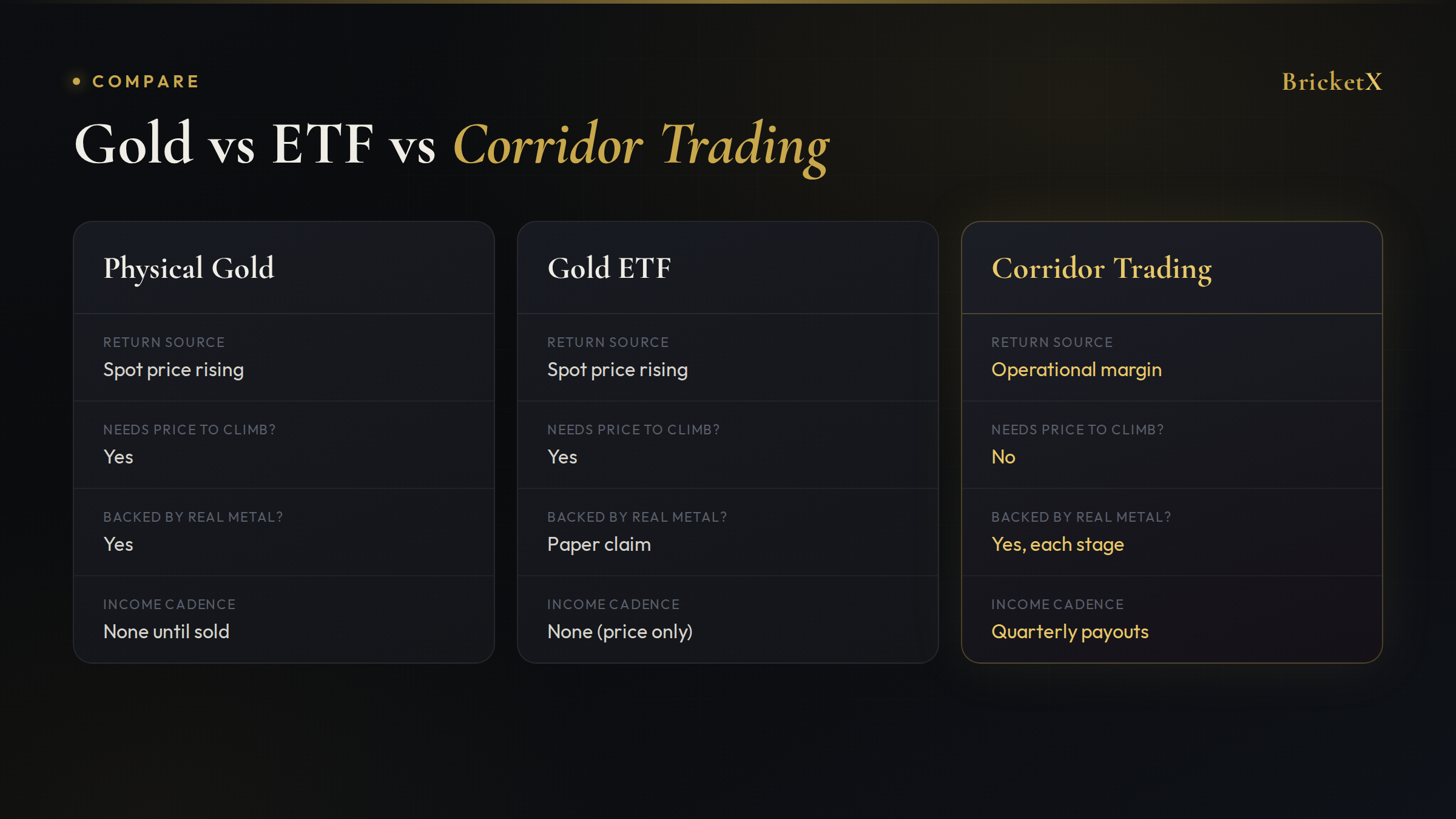
If you already hold gold or a gold ETF, this is the comparison that matters. All three give you a relationship to gold -but the return mechanism is completely different.
| Factor | Physical Gold | Gold ETF | Corridor Trading |
|---|---|---|---|
| Return source | Spot price rising | Spot price rising | Operational margin |
| Needs price to climb? | Yes | Yes | No |
| Backed by real metal? | Yes | Paper claim | Yes, at each stage |
| Liquidity | Moderate | Daily | Defined tenure |
| Income cadence | None (until sold) | None (price only) | Quarterly payouts |
These are not mutually exclusive. A common approach is to keep physical gold or an ETF for pure price exposure and liquidity, and add a corridor trading position for operational income that does not depend on the market rising. For a broader view of how this fits a portfolio, see our primer on what asset-backed investments are and why they behave differently from stocks.
How BricketX Protects Capital in the Corridor
Moving physical gold across borders is exactly the kind of operation where structure matters most. These are the protections built around the gold trading vertical:
Ring-Fenced SPV
Gold trading capital sits in its own legal vehicle, isolated from the platform's other liabilities and verticals.
Assay & Verification
Independent purity testing before purchase means capital only ever backs verified, correctly valued metal.
Insured Logistics
Gold moves under insured, compliant transport, so the position is protected while it is in transit along the corridor.
Zero Leverage
Trades are funded with real capital, not gearing -so a bad cycle cannot be amplified by hidden debt.
Independent Audit
Third-party verification of operations and returns turns reported performance into checkable performance.
Shariah-Compliant
The 70/30 Mudarabah profit-sharing structure keeps the vertical aligned with Shariah principles -profit from real trade, not interest.
The full protection framework across every vertical is detailed on the Trust & Security page, and the end-to-end process -including how the corridor connects to KYC, deployment, and payout -is on How It Works.
The Risks You Should Weigh
No honest gold investment guide skips this part. Corridor trading reduces sentiment risk, but it introduces operational ones. Understand these before you invest:
- Operational risk -sourcing, assay, and logistics must be executed well every cycle. Weak execution erodes margin.
- Price risk in transit -a sharp gold-price move while metal is in transit can compress the realised spread on that trade.
- Liquidity risk -capital is committed for a defined tenure and is not redeemable on demand like an ETF.
- Concentration risk -a position entirely in one vertical is exposed to that vertical's specific conditions; diversifying across verticals reduces it.
- Platform & structure risk -the quality of the SPV, auditing, and controls determines how well the above are contained.
Investors who want to spread this exposure often pair gold trading with other verticals -including longer-cycle gold mining -or hold a multi-asset fund that blends all five. Returns are variable and never guaranteed; the structure is designed to manage risk, not remove it.
How to Invest in the Gold Corridor
The gold trading vertical is accessible through BricketX's standard package structure:
- Minimum $50,000 across all six packages, gold trading included.
- Quarterly payouts -the most frequent cadence of any vertical, because physical gold trades recycle quickly.
- 70/30 Mudarabah split -you receive 70% of realised operational profit.
- Ring-fenced, audited, Shariah-compliant -the same protections described above, applied to every trade.
- Tenure options from one-year Bronze through five-year Premium, so you can match the position to your horizon.
The full vertical detail -including how each trade cycle is structured -lives on the Gold Trading page, and you can compare tenures and returns across the investment packages.
Frequently Asked Questions
What is an asset-backed gold investment?
What is the Kenya–Dubai gold corridor?
How does BricketX deploy capital into gold trading?
How is corridor trading different from buying gold or a gold ETF?
Is asset-backed gold investment safe?
What is the minimum to invest in BricketX gold trading?
Related Pages
Keep Reading
Disclaimer: This article is for informational and educational purposes only and does not constitute financial advice, an offer to sell, or a solicitation to buy any investment product. All figures and operational descriptions are illustrative of general investment principles unless otherwise attributed to specific BricketX package documentation. Asset-backed gold investments carry operational, logistics, price, liquidity, concentration, and platform risks. Capital committed is subject to defined tenure lock-in. Past operational performance does not guarantee future results. Consult a qualified financial advisor before making any investment decision. BricketX Global Holdings, Craigmuir Chambers, Road Town, Tortola, BVI. UAE Regional Office: Unit 906, Al Etihad Building, Port Saeed, Dubai, UAE.
More from the BricketX Blog
Is Gold a Safe Investment Asset in 2026? What HNWIs Need to Know
Gold is a safe haven, not a risk-free asset. Here is what high-net-worth investors need to know in 2026 before allocating.
Asset-Backed vs Stock Market: Which Investment Protects Capital Better?
A downturn is the only honest test of an investment. Here's a direct comparison of how asset-backed investments and the stock market each protect your capital, and where the real trade-offs lie.
Investing in Construction Projects Globally: A Guide for International Investors
You don't need a local company or a lawyer in three jurisdictions to put capital into a construction project abroad - but you do need to know exactly what stands between you and that project first.