Safe Asset-Backed Investments During Inflation: What Actually Works in 2026
Cash and bonds lose to inflation by design. Here's what the 2026 data actually shows works instead -real assets, asset-backed structures, and how to tell a genuine inflation hedge from one that only wears the label.
US inflation is running at 3.4%. Gold is trading near $4,400 an ounce, up more than 30% over the past year. Cash sitting in a bank account is quietly losing ground every month. The data this year is unusually clear about which asset types actually hold up when prices rise -and which ones only feel safe. Here's what it shows.
The Short Answer: What Actually Works Against Inflation
An asset actually protects against inflation when its value or return is tied to something real -a physical commodity, a piece of productive infrastructure, an operating margin -rather than a fixed payment set in today's dollars. Cash and fixed-rate bonds pay a return agreed in advance, so unexpected inflation quietly erodes it. Real assets -gold, commodities, development, and trading operations -have historically performed best specifically during the periods when inflation surprises to the upside, which is the regime most investors are actually worried about.
"Safe" and "inflation-resistant" are not the same thing, and 2026 has been a useful reminder why. An asset can be low-volatility and still lose to inflation every single year -a savings account is the textbook example. An asset can be genuinely inflation-resistant and still carry real risk of its own -gold and real estate both are. The question worth asking is not "is this safe" in the abstract, but does this asset's return move with prices, or was it fixed before prices moved.
The 2026 Inflation Snapshot
Numbers change monthly, so here is where things stood as this was published -useful as a reference point, not a forecast.
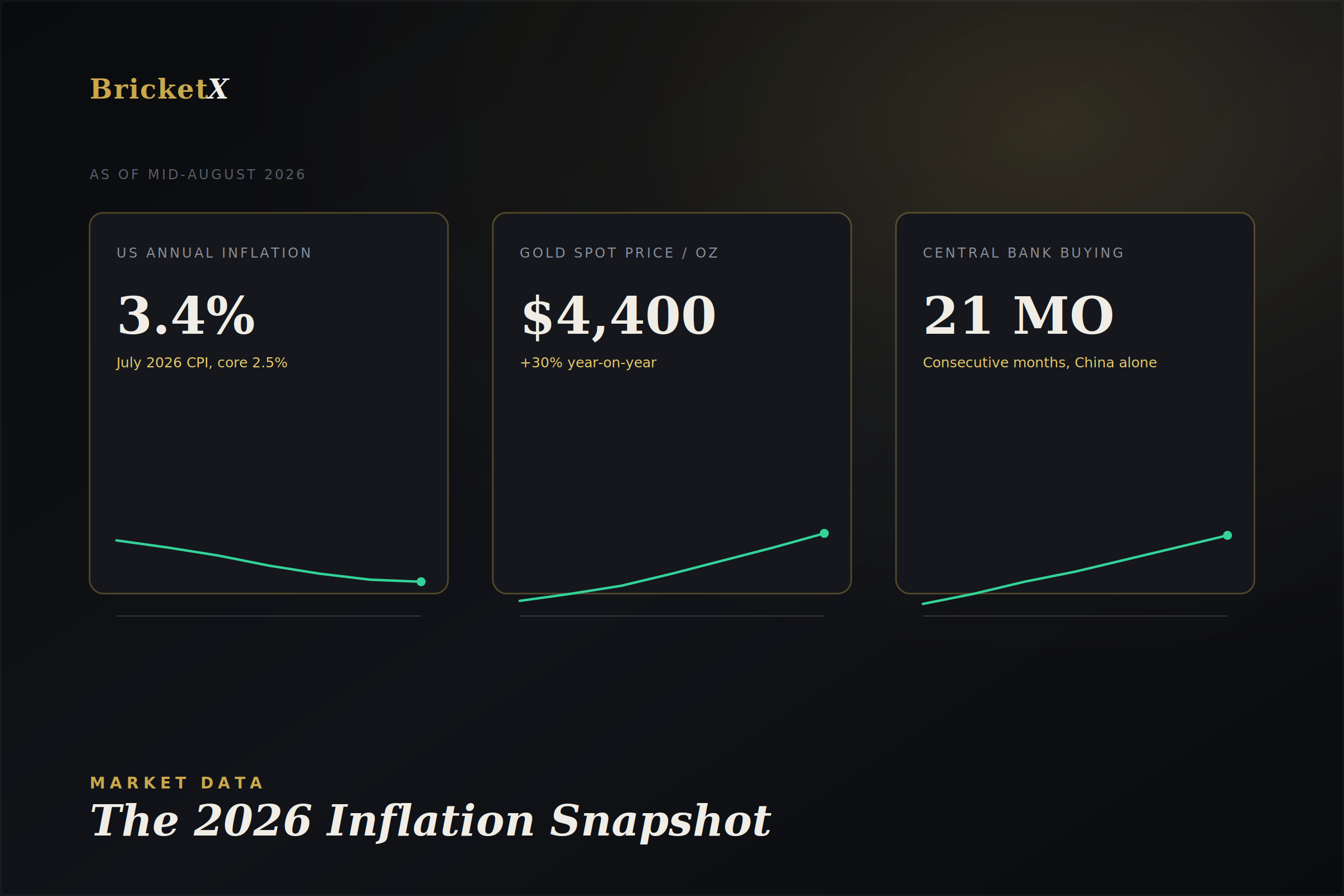
3.4%
July 2026 CPI, easing from 3.5% in June -core inflation at 2.5%.
$4,400
Up over 30% year-on-year, supported by sustained central-bank buying.
21 mo
Consecutive months of gold accumulation by China alone, into mid-2026.
Two things stand out in this data. First, headline inflation in 2026 has been driven in part by an energy-price shock tied to Middle East tensions -a reminder that inflation spikes are often triggered by events that are impossible to predict in advance, which is exactly why a fixed-income position can't react to them. Second, gold's strength this year has coincided with, not followed, the inflation and geopolitical uncertainty -central banks and institutional buyers have been positioning ahead of the data, not chasing it. It's the same pattern covered from a different angle in our piece on how Iran–US tensions are driving mining investment in Kenya.
Why Cash and Bonds Structurally Lose to Inflation
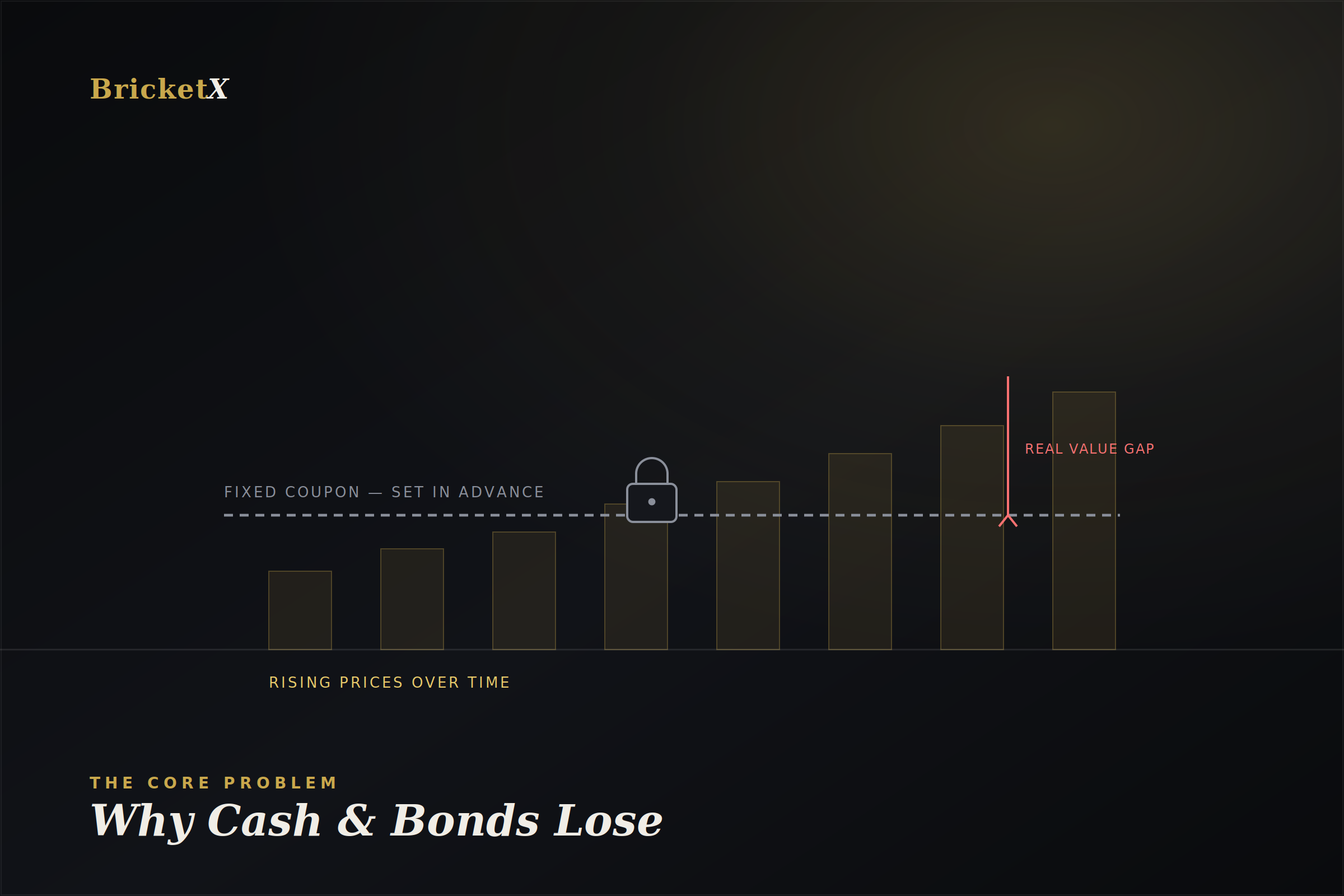
This isn't a matter of opinion -it's how the instruments are built. A savings account pays a rate set today. A bond pays a coupon fixed at issuance. Both are commitments made in today's dollars, and neither one adjusts if inflation runs hotter than expected after the commitment is made.
Research on inflation regimes is consistent on this point: cash and bonds tend to track expected inflation reasonably well over time, but they specifically underperform during periods of unexpected inflation -the exact scenario that actually threatens a portfolio, because it's the one nobody priced in. Real assets show the opposite pattern: they have historically delivered their strongest relative performance precisely when unexpected inflation is highest.
The distinction that matters: this isn't "stocks and bonds vs. real assets" as a permanent ranking -over full market cycles, equities have historically delivered strong long-run returns. It's that real assets are specifically the category built to respond when inflation itself is the surprise, which is the scenario a purely fixed-income position has no mechanism to handle.
What Actually Works: Real, Operationally-Driven Assets
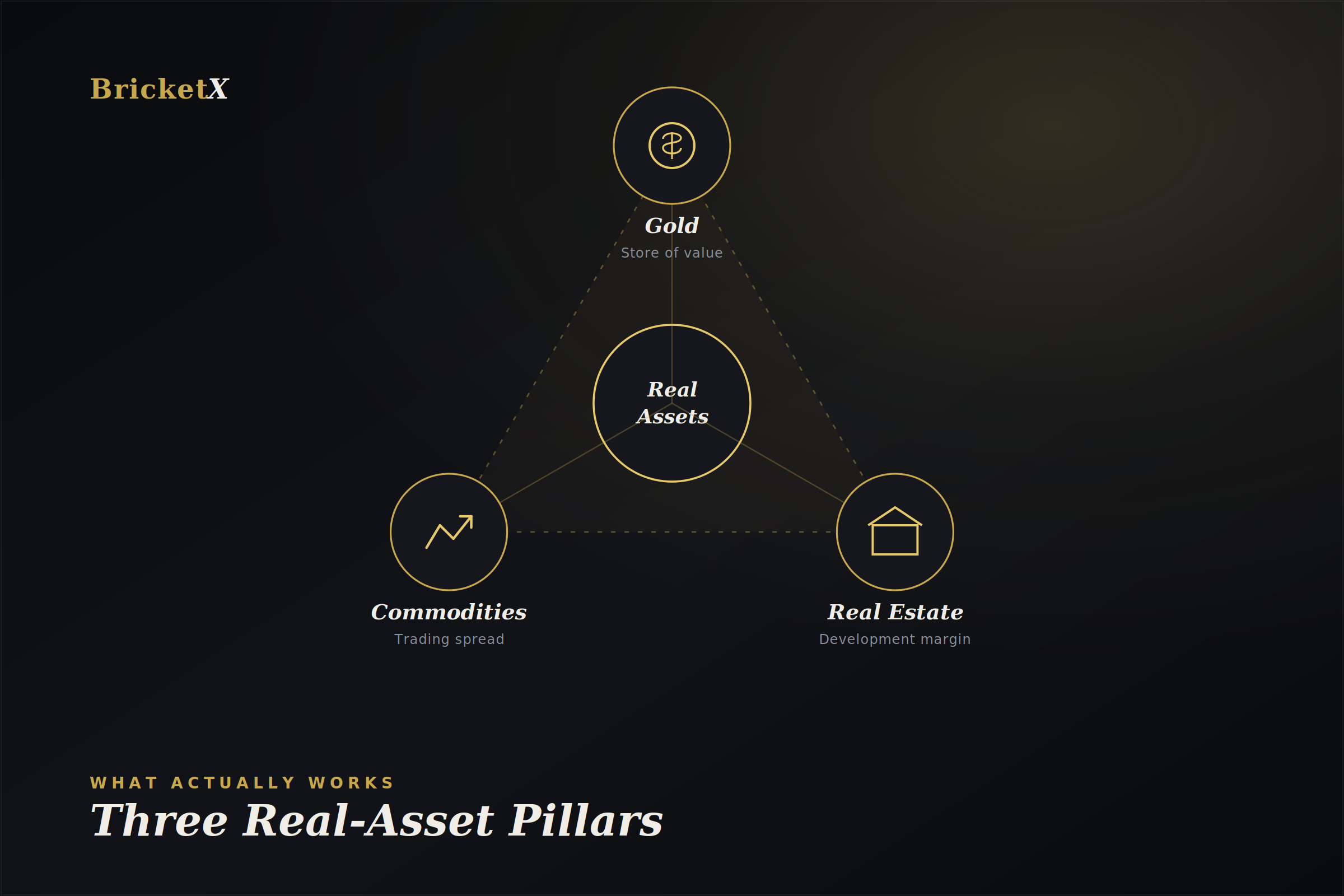
If fixed payments are the problem, the fix is a return that isn't fixed -one that comes from something real happening in the economy, whose value can move with prices rather than against them. In practice, this falls into a few categories:
Physical Monetary Assets
Gold's multi-thousand-year role as a store of value comes from scarcity, not a promise -nobody's balance sheet has to honour it. That's what makes it behave differently from cash or bonds when confidence in fixed payments falls.
Real Estate & Development
Land, construction, and finished property carry replacement cost that rises with input prices. A development margin, specifically, is priced off live build and exit costs -not a rate fixed years earlier.
Trading & Commodity Operations
A trading spread or a commodity flow is repriced constantly against the live market -it moves with prices as they change, rather than being locked in before they moved.
This is the mechanism behind BricketX's asset-backed model: capital is deployed into gold trading, real estate development, and commodities -operations whose margins are set by current market conditions each cycle, not a rate promised in advance. Our deep dive into the Kenya–Dubai gold corridor shows exactly how that trading margin is generated in practice, and for the underlying mechanics of how capital actually moves through a platform, see our guide on how asset-backed investment platforms work.
How the Main Options Actually Compare
Here's how the standard "safe" options actually behave when inflation runs hot, based on the historical pattern and current 2026 conditions:
| Asset Type | Return Source | Behaviour in Unexpected Inflation | 2026 Read |
|---|---|---|---|
| Cash / Savings | Fixed interest rate | Structurally loses | Losing ~3.4%/yr in real terms |
| Fixed-Rate Bonds | Fixed coupon | Erodes with surprise inflation | Coupon set before this year's CPI prints |
| Equities | Earnings growth | Mixed short-term | Strong long-run, volatile near-term |
| Gold | Scarcity / store of value | Historically resilient | +30%+ YoY, near record levels |
| Asset-Backed Real Assets | Operating margin | Repriced to current market | Return tied to live spreads, not a locked rate |
None of this means abandon stocks and bonds -over full cycles they remain core wealth-building tools, as covered in our primer on what asset-backed investments are and why they behave differently from stocks. It means the "safe" portion of a portfolio deserves a second look if it's entirely fixed-rate.
How an Asset-Backed Structure Actually Delivers This
Saying "real assets hedge inflation" is easy. Building a structure that actually captures that mechanism reliably is the harder part -and it's what separates a genuine asset-backed model from something wearing the label.
Capital sits in a ring-fenced SPV
Each vertical's capital is isolated in its own Special Purpose Vehicle, tied to a specific, verifiable operation rather than pooled into an opaque general fund.
Return comes from a repriced margin, not a rate
Whether it's a gold trading spread or a development margin, the return is calculated against current market conditions at the point of sale or exit -not fixed months or years in advance.
Profit is split, not promised
The 70/30 Mudarabah profit-share means investors participate in whatever margin the operation actually generates -there is no fixed coupon to be eroded by inflation, and no guaranteed number disconnected from real performance.
Independent verification backs every figure
Audited financials and independent valuation stand behind the reported margin, so "asset-backed" describes the actual structure -not just the marketing copy.
The full protection framework is detailed on Trust & Security.
The Warning Most Guides Skip: Not Everything "Asset-Backed" Is Safe
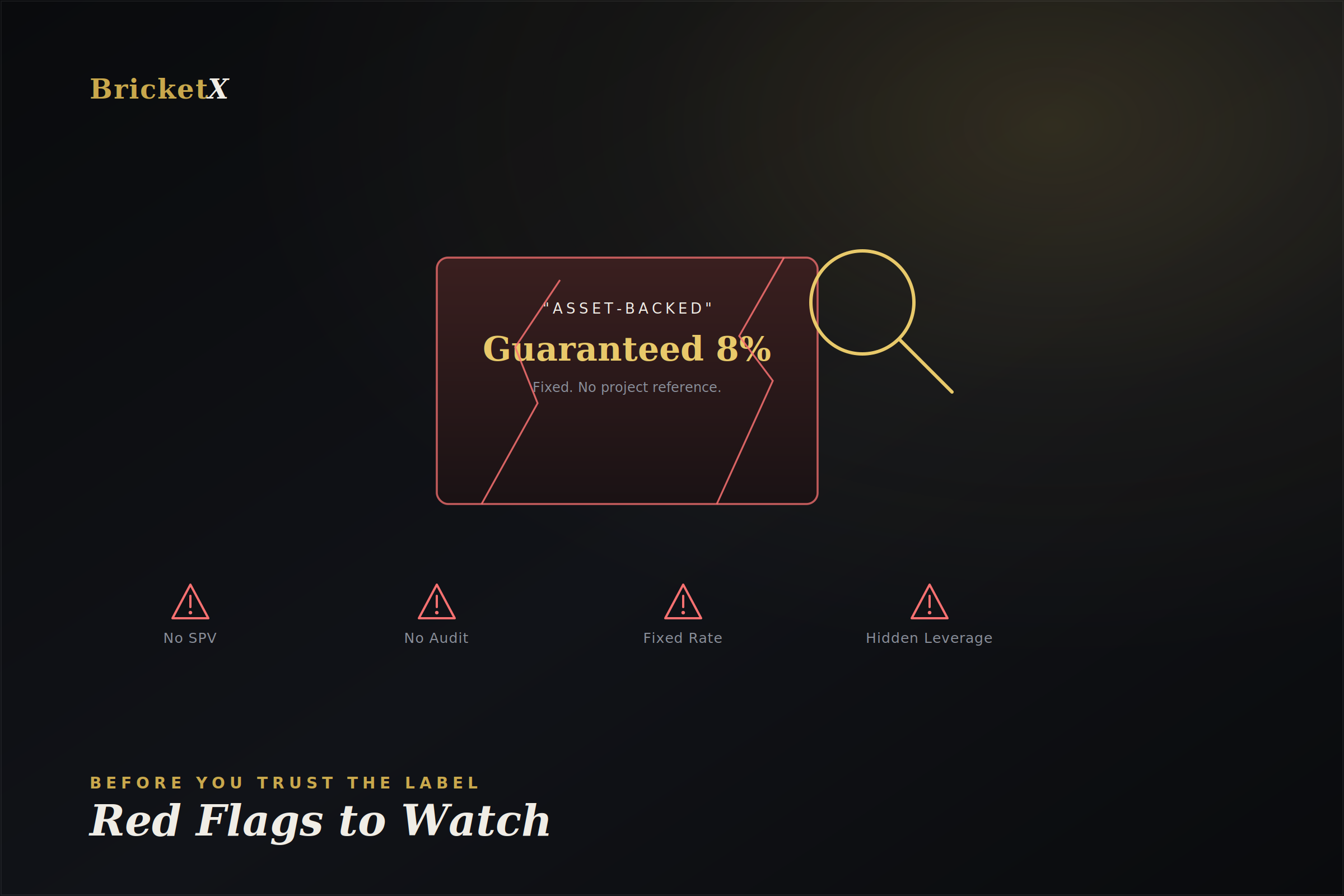
"Asset-backed" has become a popular label precisely because inflation has made people look for it -which means it also gets attached to structures that don't actually behave the way the term implies. Before treating any platform's return as an inflation hedge, check for these:
Red flag: a fixed, guaranteed return quoted with no reference to a real operation. If the return doesn't move with the underlying market -gold prices, construction costs, trading spreads -it isn't actually capturing the inflation-hedging mechanism, whatever it's called. A genuine operating margin fluctuates with real conditions; a number that never changes usually means the "asset" is decorative.
- No ring-fenced structure. If capital isn't isolated per project or vertical, "asset-backed" may just mean the platform owns some assets somewhere, not that your specific capital funded one.
- No independent audit or verification. Reported margins should be checkable against something outside the platform's own claims.
- Returns disconnected from the asset's actual market. Gold-backed products should move roughly with gold; development returns should reflect real construction and exit conditions.
- Leverage hidden inside the structure. Debt-amplified "real asset" returns carry a different, larger risk profile than the underlying asset itself.
This is exactly why structure -not the label -is the section worth reading closely on any platform, covered in full in our guide to how asset-backed investment platforms work.
How to Build an Inflation-Resilient Portfolio in 2026
Putting this together into an actual allocation approach:
Separate expected from unexpected inflation
Cash and bonds are priced for what's already anticipated -the risk worth hedging is the surprise, which is where real assets specifically outperform.
Anchor with a physical, monetary asset
A core gold position, sized to what you can hold through volatility, has the longest track record of any single asset here.
Add operationally-driven real assets
Development margins, trading spreads, and commodity flows generate returns that reprice with the market rather than eroding against it -the same logic behind BricketX's real estate development investment vertical.
Verify the structure behind any "asset-backed" claim
Ring-fenced SPV, independent audit, verifiable operation -confirm all three before treating a return as a genuine hedge.
Diversify across verticals, not just asset labels
A single commodity cycle or project shouldn't determine the whole outcome -which is the logic behind holding multiple verticals or a multi-asset fund.
"Inflation doesn't ask permission before it runs hot. The only real defence is holding assets whose returns were never fixed in the first place."
-BricketX Editorial Team
How to Invest With BricketX
BricketX's structure is built around the mechanism this article describes -capital deployed into real, operationally-driven assets rather than fixed-rate instruments:
- Minimum $50,000 across all six packages.
- Five real-asset verticals -gold trading, real estate development, commodities, gold mining, and e-commerce -plus a multi-asset fund blending all five.
- 70/30 Mudarabah split on realised, repriced operating margin -never a fixed coupon.
- Ring-fenced, audited, Shariah-compliant structure behind every vertical.
Compare tenures and verticals on the investment packages page, or see the full breakdown of each real-asset operation on Investments.
Frequently Asked Questions
What actually protects against inflation in 2026?
Is gold still a good inflation hedge in 2026?
Are asset-backed investments safe during inflation?
Why do bonds and cash lose value during inflation?
What's the difference between asset-backed investments and just buying gold or property?
How much of a portfolio should be in inflation-resistant assets?
This article is produced by BricketX for informational and educational purposes only. It does not constitute financial advice, an offer to sell, or a solicitation to buy any investment product. Market data (inflation figures, gold prices, and related statistics) reflects publicly reported figures as of mid-August 2026 and is subject to change; consult live sources for current data before making decisions. Asset-backed investments carry market, execution, liquidity, concentration, and platform risks, including the risk that real-asset prices can also fall. Past performance, including historical inflation-hedging behaviour, does not guarantee future results. Returns stated are targets, not guarantees. KYC/AML verification is required for all investment participation. Prospective investors should conduct their own due diligence and consult a qualified financial adviser.
More from the BricketX Blog
Is Gold a Safe Investment Asset in 2026? What HNWIs Need to Know
Gold is a safe haven, not a risk-free asset. Here is what high-net-worth investors need to know in 2026 before allocating.
Asset-Backed vs Stock Market: Which Investment Protects Capital Better?
A downturn is the only honest test of an investment. Here's a direct comparison of how asset-backed investments and the stock market each protect your capital, and where the real trade-offs lie.
Investing in Construction Projects Globally: A Guide for International Investors
You don't need a local company or a lawyer in three jurisdictions to put capital into a construction project abroad - but you do need to know exactly what stands between you and that project first.